
stories
The Energetic and Spiritual Characteristics of Emeralds
How crystal traditions describe emerald's energetic and spiritual properties — and how to read those descriptions without losing the science underneath.
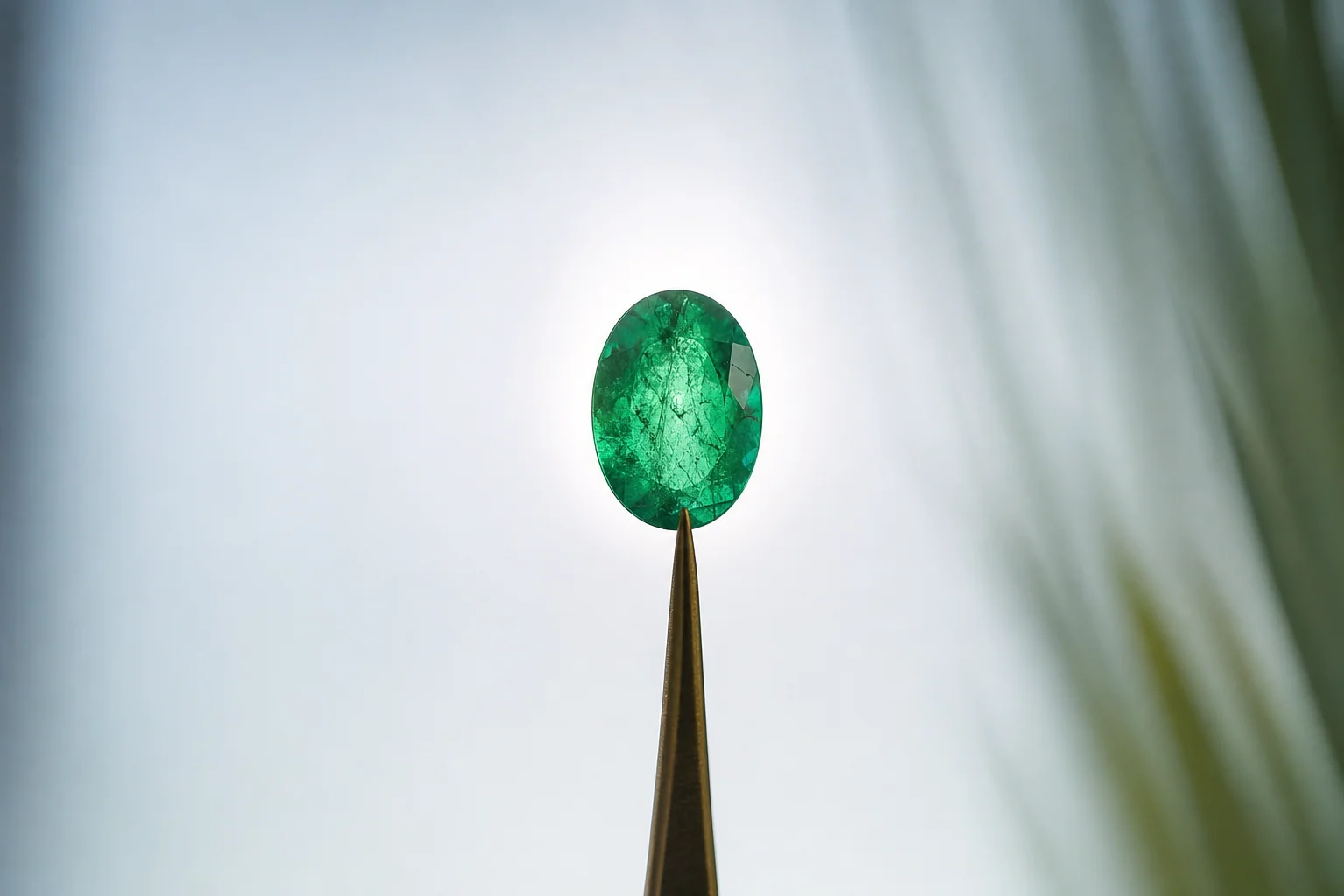
Across crystal healing, energetic-medicine and contemplative traditions, emerald has accumulated a particularly rich vocabulary of spiritual association. It is called the stone of the heart chakra, the stone of patient growth, the stone of truthful communication, the stone of unconditional love. This piece looks carefully at those associations — what each tradition actually claims, where the claims come from, and how a wearer can engage with the language without losing the gemological reality of the stone.
What “energetic” means in this context
Energetic and spiritual descriptions of gemstones are not gemological claims. They do not pass the tests that the GIA or SSEF would apply to verify a stone. They are descriptions in a different register — phenomenological, contemplative, sometimes ritual — that have accumulated across centuries of practice in cultures including Vedic, Tibetan, Chinese, classical European, Andean and contemporary New Age traditions.
These descriptions are useful to many wearers. They give the stone a vocabulary beyond its physical properties; they connect contemporary jewellery to ancient practices; they offer a contemplative posture that some wearers find meaningful. They are not, however, a substitute for the certificate, the cut quality, or the +Care rhythm that any fine gemstone deserves.
The framework of this piece is: take each spiritual claim seriously enough to describe what it asserts, without overclaiming what the stone “does” in any empirically demonstrable sense.
Emerald and the heart chakra
In the Indian-derived chakra system that has been adopted into much contemporary Western crystal practice, emerald is associated primarily with the heart chakra (anāhata) — the energetic centre located at the centre of the chest, traditionally connected to love, compassion, grief, and the capacity to give and receive emotion openly.
Practitioners working with emerald in this framework typically use the stone in three ways:
Meditation. Holding emerald against the heart centre during meditation as a focal object for attention to that area. The green colour, combined with the stone’s optical depth, can serve as a useful contemplative anchor.
Worn at chest level. Emerald pendants or necklaces are favoured in this tradition specifically because the stone rests near the heart centre during daily wear. Emerald engagement rings are sometimes interpreted the same way — the wearer carrying a piece of heart-chakra material consistently.
Ritual placement. In specific energetic-healing modalities, emerald is placed directly on the chest during sessions, with the practitioner working with the stone as a focusing tool.
What the chakra framework asserts is that emerald’s colour and structure resonate energetically with the heart centre — supporting openness, emotional steadiness, and the capacity for love that is both vulnerable and resilient. The claim is contemplative; the practice is real and consistent across many traditions.
Emerald and unconditional love
The phrase “unconditional love” appears across many crystal-healing texts in connection with emerald. The distinction being drawn is between love that has conditions (love-because-of, love-as-long-as) and love that does not (love-anyway, love-even-when). Emerald is repeatedly associated with the latter — sometimes as a tool for cultivating it, sometimes as a reminder of its possibility.
This is symbolic language with a specific function. The wearer of an emerald — particularly an emerald engagement ring or anniversary piece — can read the stone as a daily reminder of a commitment to non-transactional love. Whether the stone causes that posture or merely supports it is a question the wearer can answer for themselves.
Emerald and clear communication
A second consistent association is between emerald and truthful speech. This thread runs from medieval European lapidaries (where emerald was the “stone of truth”) through Mughal court practice (where the stone was used divinatorily) to contemporary crystal-healing texts (which describe emerald as supporting honest expression of feeling, especially around love).
For a wearer, this thread translates into a contemplative practice: the stone as a reminder to speak truthfully in matters of the heart. The wearer wearing emerald during a difficult conversation about feelings, or during a relationship transition, can read the stone as supporting the difficult work of saying what is actually true.
Emerald and patient growth
The colour green is universally associated, across cultures, with the slow renewal of vegetation — the patient growth of spring after winter. Emerald inherits this association and adds its own gemological character: a stone that grew, over geological time, in a slow accretion of beryllium and aluminium within a specific tectonic context. The patience required to make an emerald is, in this framework, the patience required to make any durable thing — including a relationship, a vocation, a life.
Wearers in contemplative traditions sometimes use emerald specifically during periods of long-term work that requires sustained attention without immediate reward. A piece of emerald jewellery worn during graduate study, a long creative project, the early years of a marriage, or the cultivation of a contemplative practice — the wearer reads the stone as a reminder that growth happens slowly, and that the slowness is the work.
The Tibetan and Chinese traditions
Tibetan crystal practice associates emerald with the bodhisattva of compassion (in some lineages, Tara) and with the cultivation of bodhicitta — the awakened heart-mind of Buddhist practice. Emerald used in Tibetan contemplative context is typically a small piece placed on a personal altar or worn as an amulet, not a centrepiece in fine jewellery.
Chinese energetic-medicine traditions associate emerald with the wood element — the principle of growth, expansion, and the renewal of life force after winter. Emerald in this tradition can support the liver-and-gallbladder meridian system and the emotional health (particularly the resolution of anger and the cultivation of patience) traditionally associated with the wood element.
These traditions are not the dominant Western framework, but they enrich the global picture of emerald’s spiritual vocabulary.
How to engage without overclaiming
Many contemporary wearers find energetic and spiritual associations with gemstones meaningful but are wary of overclaiming what the stones empirically “do.” A reasonable approach:
Treat the symbolism as an invitation, not a guarantee. The stone invites a particular contemplative posture (open-hearted, patient, truth-telling). Whether you take up the invitation is your work.
Keep the certificate honest. A stone with rich spiritual associations is still a stone with a specific origin, treatment history, and gemological quality. The spiritual framework does not exempt the stone from these facts.
Practice consistently. The energetic frameworks describe stones as tools for ongoing practice, not amulets that work on contact. A wearer who engages with emerald contemplatively over years gets a different relationship to the stone than one who simply wears it.
Hold both registers. The wearer can know that the emerald is a beryl coloured by chromium, with a specific certificate from a Colombian deposit, and read it as a heart-chakra stone supporting patient growth. The two registers do not exclude each other.
A short reference
- Heart chakra (anāhata): principal energetic association in the Indian-derived framework.
- Unconditional love: repeated symbolic association across crystal-healing literatures.
- Truthful communication: thread running from medieval lapidaries to contemporary practice.
- Patient growth: colour-based association with the slow renewal of vegetation.
- Wood element (Chinese tradition): growth, expansion, renewal of life force.
- Bodhicitta (Tibetan tradition): awakened heart-mind, contemplative practice.
The wearer brings the framework. The stone, properly certified and well set, supports whichever framework the wearer chooses.