
engagement-rings
The Latest in Engagement Rings
A measured look at the design movements actually shaping engagement rings right now — not the trend pieces, the structural shifts.
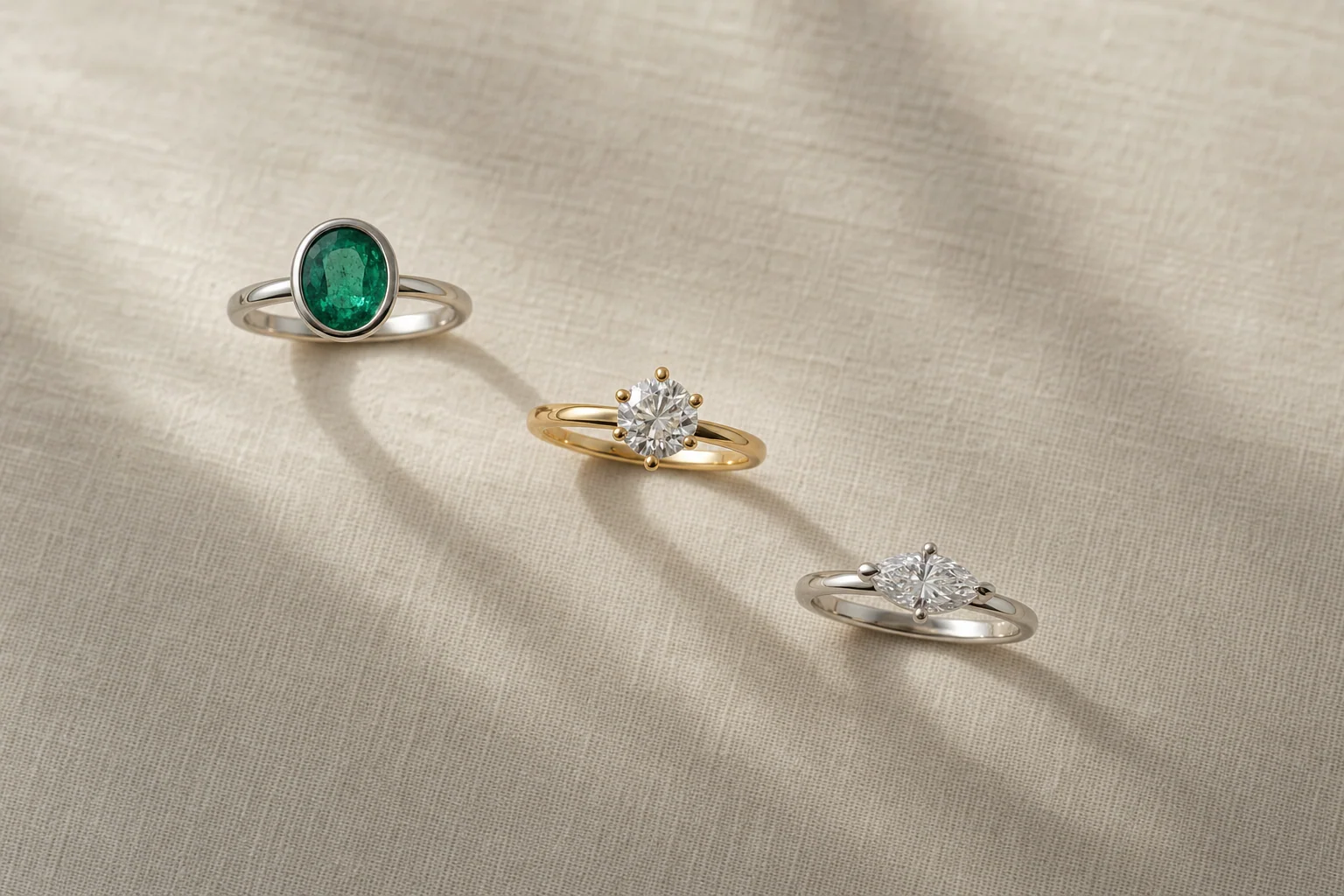
“The latest in engagement rings” is a phrase that ages badly. The genuine movements in fine jewellery happen slowly — they take years to settle, decades to define an era. What follows is not a trend piece. It is a measured look at the shifts that are actually shaping new commissions today, with enough distance from the cycle to be worth reading next year.
Coloured stones have moved from accent to centre
For most of the post-war engagement-ring era, white diamond was the default centre stone. Coloured gemstones existed in fine jewellery, but they sat on the periphery — accent stones in three-stone designs, statement pieces for occasions, hereditary heirlooms.
That hierarchy has flattened. Sapphire (especially teal sapphire from Madagascar), tourmaline (Paraíba from Brazil, indicolite from Afghanistan), alexandrite (Brazilian or Russian when available), spinel and emerald are increasingly chosen as the centre stone of new commissions — not as bold deviations from the norm, but as straightforward choices made by wearers who simply prefer colour.
The shift correlates with two structural changes: improved supply-chain transparency for coloured stones (gemological certification now routinely identifies origin and treatment), and a generational broadening of what an engagement ring is expected to look like.
Cushion and oval are eating the round
Round brilliant remains the most common centre cut, but the share of cushion brilliant and oval is rising decisively. The reasons are practical: cushion cuts hold colour better than rounds (relevant when the wearer has chosen a coloured stone), oval shapes elongate the finger visually, and both cuts retain more carat weight from the original rough than a round, which can mean a more advantageous price for a given visual size.
Pear, marquise and emerald cuts continue to occupy specialist niches but have not broken through to the mainstream cushion-and-oval is currently occupying. Round will remain the safest, most timeless choice; cushion and oval are where the most interesting new commissions live.
Settings have lowered
The ultra-tall solitaire setting that defined the late twentieth century — a head perched high above the band, the stone visually disconnected from the metal — has gradually given way to lower-profile settings. Cathedral solitaires with reduced height, bezel and half-bezel settings, hidden-halo designs that bring the centre stone closer to the finger.
The practical driver is durability. A lower-profile setting snags less on clothing, takes fewer hand impacts directly, and ages better. The aesthetic driver is integration. Modern wearers tend to prefer pieces that look like a single object, not a stone perched on a stand.
Metal preferences are shifting
Platinum continues to be the gold standard (literally) for fine engagement rings — it is the hardest commonly-used metal, it does not lose mass when polished, and it holds settings with the least fatigue over time. But yellow gold has returned strongly after a long absence, and rose gold has carved out a durable niche.
White gold, paradoxically, is losing share. The thin rhodium plating that gives white gold its bright finish needs replating every few years; many wearers who learn this fact choose platinum (more durable, requires no plating) or yellow/rose gold (different aesthetic, no plating issue) instead.
The decision is not about cost — platinum is more expensive per gram than gold of the same purity, but the difference for a typical ring is modest. The decision is about what the wearer wants the piece to look like in twenty years.
Lab-grown is now a category, not a fringe
In 2018, lab-grown diamonds were a fringe choice in fine jewellery. In 2025, they are a category — accepted by reputable maisons, certified by major gemological labs, chosen by mainstream wearers for reasons that include price, transparency, and ethics.
The conversation has matured beyond “are they real diamonds?” (they are; the chemistry is identical) to “what value structure does a lab vs mined stone represent for you?” Lab-grown offers accessibility and supply-chain certainty. Mined offers geological history that cannot be replicated. Both are valid choices for an engagement ring. What matters is that the choice be transparent on the certificate and in the ÊTRUNE ID record.
Personalisation has gone deeper
A decade ago, “customisation” mostly meant choosing a centre stone from a small set and a band from another small set. Today, customisation increasingly means co-designing — the wearer participates in decisions about stone shape, band profile, prong style, finish, engraving, and the proportions that bind them together.
This is enabled by 3D modelling, augmented-reality preview, and atelier workflows that handle bespoke commissions at scale. It is not unique to ÊTRUNE — most serious maisons offer it now — but it has changed the implicit contract of an engagement-ring purchase. The wearer is no longer choosing; they are commissioning.
What stays the same
The structural facts of an engagement ring have not changed:
- It is worn every day, for decades.
- The setting must hold the stone against thousands of small impacts.
- The metal must wear honestly without becoming a maintenance burden.
- The piece is meant to outlive any trend it was bought during.
A maison that designs against this constancy will produce rings that age well regardless of which “trend” defined the year of their commission. The current moment of coloured stones, cushion cuts, lower settings, mixed metals, lab-grown options and deep personalisation is unusually rich — but the pieces that will look best in 2055 will be the ones that respected the structural facts beneath the surface shifts.
A short reference
- Currently rising: coloured centre stones, cushion and oval cuts, lower-profile settings, platinum and yellow gold, lab-grown as legitimate option, deep personalisation.
- Currently fading: ultra-tall solitaire heads, white-gold-as-default, round-as-only-acceptable centre cut, white-diamond-as-required centre stone.
- Currently stable: the requirement that a daily-worn ring must survive daily wear, the value of independent certification, the role of +Care in extending a piece’s life.
The latest in engagement rings is, in 2025, more interesting than it has been in years. The next decade will likely be more interesting still.