
design
The Art of the Reset Stone
How a heirloom gemstone is given a second life — the inspection, the model, the new setting, and the conversation that decides everything.
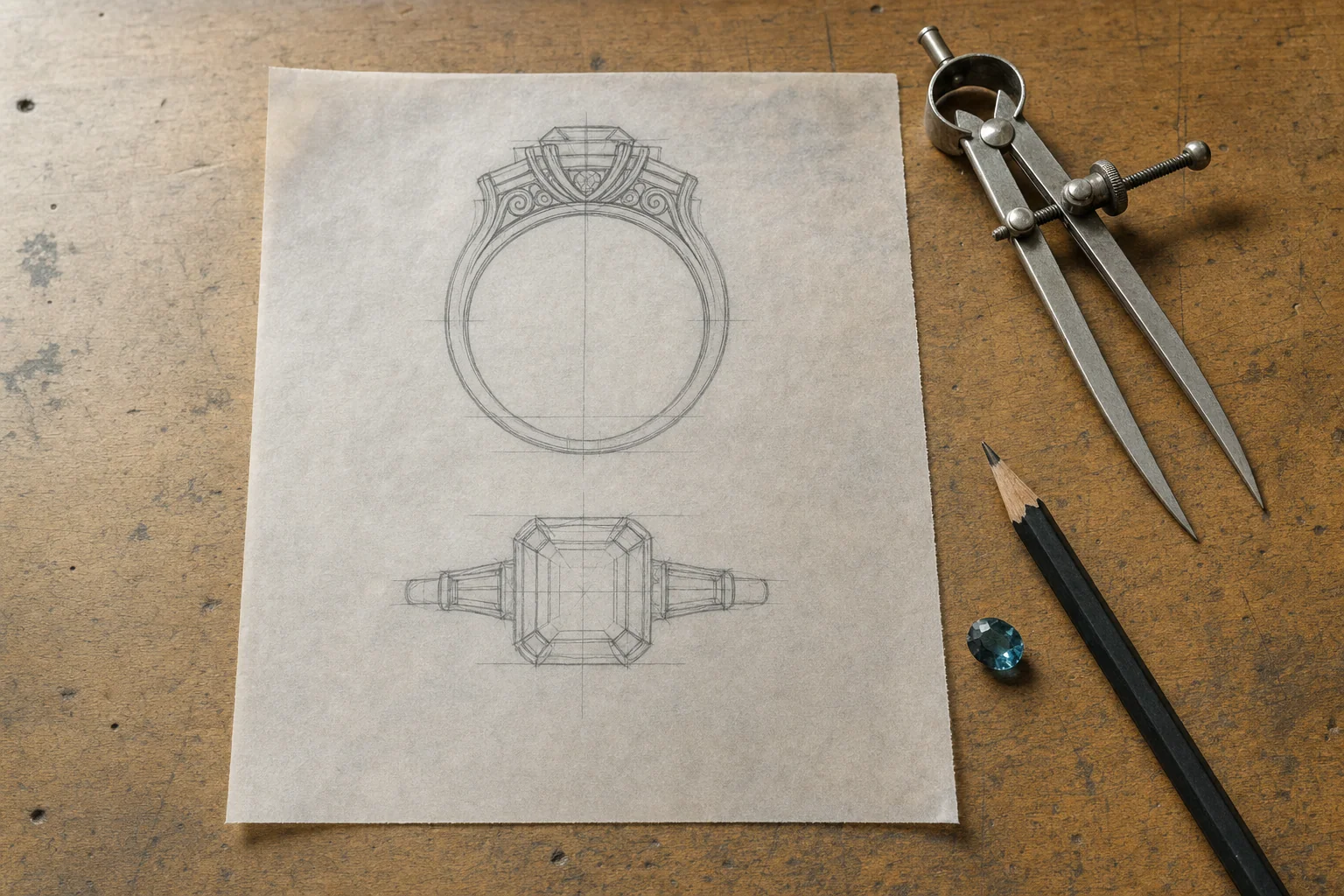
There is a small, quiet category of commission that any serious atelier learns to handle with extra care: the reset stone. A gemstone arrives — sometimes loose, sometimes still in its original setting — with a story attached. Grandmother’s diamond. A sapphire from a marriage that ended. A coloured stone bought on a trip and never quite found the right ring. The client is not asking for a new gem. They are asking for a new chapter for a gem that has lived. This guide explains how that chapter gets written.
Why people reset, and what changes when they do
The reasons cluster into three kinds. The first is inheritance: a parent or grandparent passed a stone (or a complete piece) and the wearer wants to bring it into the present. The second is renewal: a stone from a previous chapter — an engagement that did not become a marriage, a piece bought for someone who no longer wears it — needs to step into a new identity before it can be worn again. The third is upgrade: a stone whose original setting always felt slightly off, and the wearer wants to fix the geometry without abandoning the gem itself.
What changes when you reset, technically, is almost everything except the gem. The metal can change. The design can change. The proportions of the band, the shape of the prongs, the angle at which the stone sits — every decision is open. What you keep is the centre stone and, often, a smaller piece of metal or an engraving you want preserved.
What changes emotionally is harder to describe. A reset piece is not the same as a new piece — it carries a thread from before, and the thread is the point.
Step one: the inspection
Before any design conversation, the atelier inspects the stone. We loupe it under daylight and under a calibrated lamp, weigh it on a calibrated scale, measure it to the tenth of a millimetre, and identify the variety and likely treatment history. If a certificate exists, we read it carefully and ask whether the wearer trusts the certificate’s age and source. If no certificate exists, we recommend producing a new one — partly for the ÊTRUNE ID record we will build for the finished piece, partly because the client deserves to know exactly what they are working with before any design choice is made.
We also look for damage that is easy to miss. Chips at the girdle, abrasion along facet edges, scratches across the table, a culet that was struck during a previous service. None of these necessarily disqualify the stone for setting, but they affect the type of setting that will work best. A stone with a slightly chipped girdle, for example, cannot sit in a bezel that exposes the rim — it needs a setting that protects the damage.
Step two: the conversation
The design conversation for a reset is different from the conversation for a brand-new commission. With a new commission, the client is choosing from open possibilities. With a reset, the client is balancing memory and present life.
We ask several specific questions:
- What about the original piece, if there was one, do you want to keep? The cut of the stone? The metal colour? A particular line in the band?
- What about the original piece do you want to release? Sometimes the answer is “everything except the stone.” Sometimes it is “almost nothing — just the proportions.”
- How will this piece live in your day? An engagement ring lives differently from a right-hand statement piece. The same stone in two destinations becomes two different rings.
- Is this for you, or for someone else? Resets done as a gift carry an additional layer of conversation: the giver wants a piece that respects both the inheritance and the receiver’s taste.
Answers to these questions become the brief. We sketch from the brief, not from the stone alone.
Step three: the model
Once the brief is settled, we move to a 3D model. The model is not just a render — it is a precise digital twin of the proposed ring, with the existing stone’s measurements built into the seat. This matters because a reset stone is not interchangeable: it has its exact dimensions, its exact girdle thickness, its exact pavilion depth. The setting has to be engineered around what is, not around what is typical.
We present the model from multiple angles and at scale. The client lives with it for a few days, sometimes weeks. Revisions happen. When the model is approved, we sign off — and only then does the physical work begin.
Step four: the new piece
The atelier produces the band in the agreed metal, prepares the setting to the calibrated specifications of the existing stone, and engineers any structural elements the design requires (under-bezel, basket, hidden halo, milgrain). When everything is ready, a master setter brings the stone into the new ring under loupe, secures the prongs to the calibrated angle, and inspects the result against the original brief. Photographs and the ÊTRUNE ID record are produced and added to the piece’s expediente.
What was a stone is now a ring. The conversation that produced it lives in the file.
What we ask the client to consider, before deciding
A reset is irreversible. The original setting goes away. The new setting is now the home of the stone. We invite anyone considering a reset to sit with the decision long enough to be sure — and to make the decision for the right reasons. The stone does not need a reset to be loved. The reset is for the wearer, not for the gem.
When the decision is the right one — and most of them are — the result is a piece that wears beautifully, that holds a thread of memory, and that begins its own document inside ÊTRUNE ID. The second chapter starts the day the ring goes back on the hand.
A short reference
- What stays: the centre stone (and any small piece of metal or engraving you ask us to preserve).
- What changes: band metal, design, proportions, setting style, finger size.
- What is documented: the original certificate (if any), the new certificate from the atelier inspection, the design brief, the 3D model, the production steps, the final photographs — all in ÊTRUNE ID.
- Typical timeline: four to eight weeks between brief approval and finished delivery.
- When +Care begins: the day the piece is delivered. Annual visits continue from there.
A reset is one of the most personal commissions an atelier ever takes on. We treat it accordingly.