
gemstones
The Emerald: A Fascinating Gemstone
An introduction to what makes emerald distinct — its chemistry, its colour, its sources, its treatments, and what the wearer should know before choosing one.
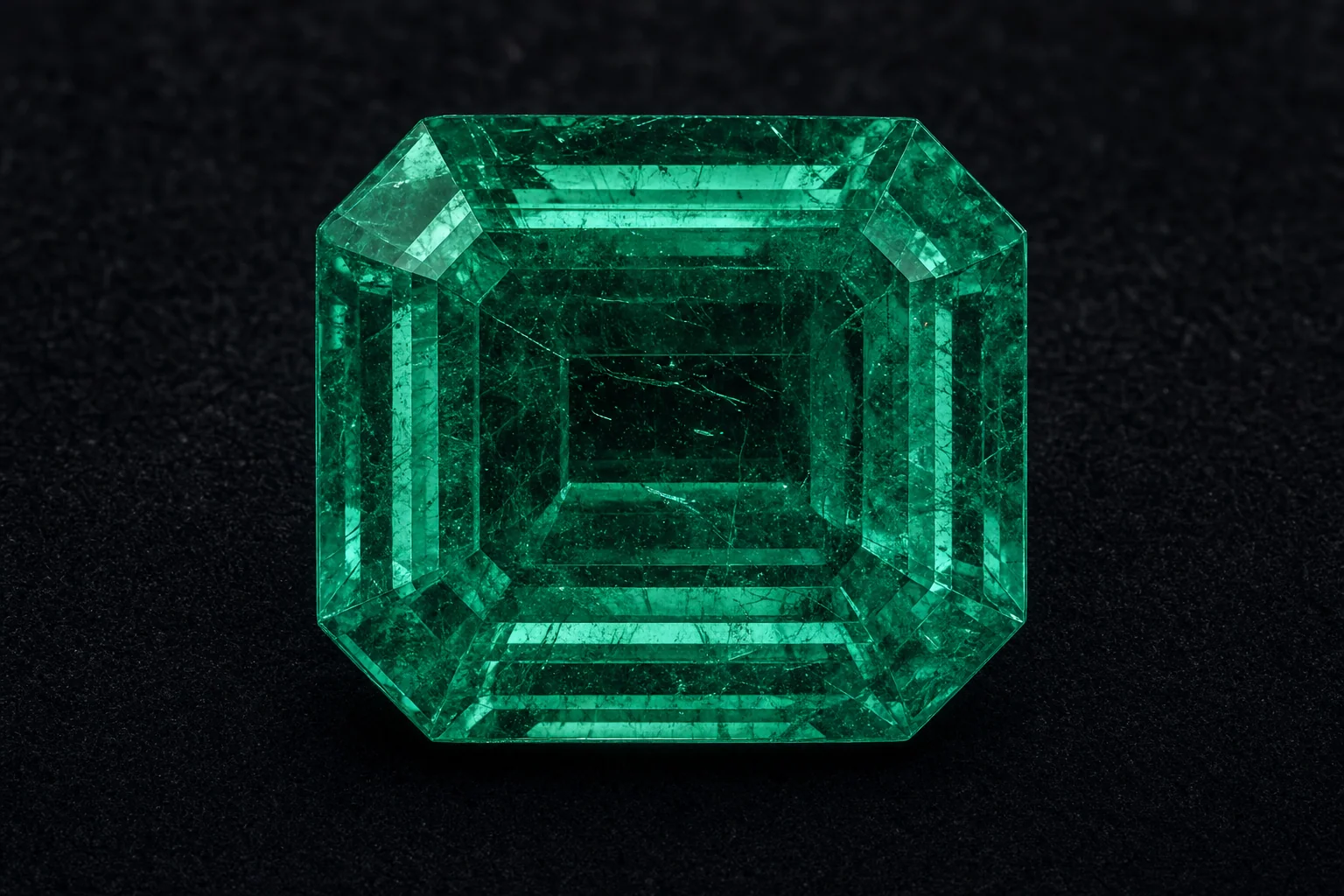
Emerald is the green variety of beryl, the gemstone that has carried symbolic weight across more cultures and more centuries than almost any other. For anyone considering an emerald — for an engagement ring, a heritage piece, a personal commission — this piece is the introduction the gemstone deserves. We cover what emerald is chemically and gemologically, where it comes from, how it is treated, what makes one emerald different from another, and what the wearer should know before choosing.
What emerald actually is
Chemically, emerald is beryllium aluminium cyclosilicate (Be₃Al₂(SiO₃)₆) — a beryl whose distinctive green colour comes from trace amounts of chromium, vanadium, and (to a lesser extent) iron. Pure beryl is colourless; emerald exists because of these trace impurities, present in specific ratios that vary by geological deposit.
The green of emerald is unique among gemstones. The brain perceives it as more saturated than any other natural green, partly because the chromium-induced fluorescence makes the colour appear to “glow” under certain lighting. This is the optical signature that distinguishes a fine emerald from a similarly-coloured but less expensive gem like tsavorite garnet or chrome diopside.
Hardness, brittleness, and what they mean for wear
Emerald measures 7.5 to 8 on the Mohs scale of hardness — hard enough to be a daily-wearable gemstone, but lower than ruby, sapphire (both 9), or diamond (10). More important than hardness is brittleness: emerald is famously fracture-prone because the geological conditions that produce the stone almost always include internal stresses that leave behind microscopic and macroscopic fissures, called “jardin” (French for “garden”) in the trade.
The combination of moderate hardness and significant brittleness means that an emerald engagement ring requires more care than a diamond or sapphire engagement ring. The wearer should remove the piece for impact activities (sport, hard manual labour), avoid contact with hot water or steam, and not use ultrasonic cleaners. With those precautions, an emerald in a well-engineered setting can be worn daily for decades.
The four origins that matter most
In contemporary global trade, four origins dominate the fine emerald market:
Colombia. The historical reference standard. Produces the warmest, most saturated green at high quality. The major deposits — Muzo, Chivor, Coscuez — each produce a recognisably distinct colour signature.
Zambia. The second-most-important origin since the 1970s. Produces a slightly bluer green than Colombian, with generally higher iron content. Zambian emerald tends to be more included but also more durable.
Brazil. Major producer of large emeralds, particularly from Minas Gerais, Bahia and Goiás. Brazilian colour is more variable; the best Brazilian material rivals fine Colombian, but a larger share of Brazilian production is commercial-grade.
Ethiopia. The newest significant source, with the Shakiso deposit emerging in the 2010s. Produces some material of exceptional clarity and saturation; market position is still being established.
Other sources (Pakistan, Afghanistan, Russia, Madagascar, Zimbabwe) contribute smaller volumes. Each origin leaves a recognisable trace-element signature that a reputable gemological laboratory can detect and certify.
The four Cs, adapted for emerald
The diamond grading framework — colour, clarity, cut, carat — applies to emerald with modifications:
Colour. This is the dominant factor for emerald. Fine emerald colour is a saturated, slightly bluish-to-grass-green hue, with medium-to-medium-dark tone, and high saturation. The GIA grading system uses combinations of these parameters. Origin influences expected colour: Colombian tends warmer, Zambian cooler.
Clarity. Emerald is classified as Type III — heavily included by default. The trade accepts and even values jardin inclusions as evidence of natural origin and Colombian provenance. Eye-clean emeralds exist at the top of the market and command commensurate prices, but most fine emeralds show some inclusions visible under careful inspection.
Cut. Most fine emeralds are cut in the “emerald cut” (step-cut with truncated corners) precisely because that geometry maximises colour expression and minimises stress on a brittle stone. Cushion, oval, pear and round brilliant cuts also occur in fine emerald, each with its own visual advantages.
Carat. Emerald loses approximately 50–60% of rough weight in cutting, so finished stones above 3 carats are relatively rare. Stones above 5 carats are exceptional. Stones above 10 carats are extraordinary and typically command very high per-carat prices.
Treatment: the cedar-oil tradition
Almost all fine emeralds are oil-treated. Surface-reaching fractures are filled with cedar oil (traditional) or modern epoxy resin (more durable but increasingly debated). The treatment fills the fractures, reduces their visibility, and improves the apparent clarity of the stone.
The trade has accepted oil-treatment as standard for centuries — it is disclosed on every reputable certificate, and the wearer should not be surprised by it. What matters is the degree of treatment (described as “minor,” “moderate,” or “significant” on GIA certificates) and whether the treatment is cedar oil (traditional, must be reapplied every few years) or modern resin (more durable, can have ethical or value implications).
Untreated emerald — sometimes called “no oil” — exists and is extraordinary. A genuinely untreated emerald with eye-clean clarity is one of the rarest objects in the gemstone trade and is priced accordingly.
Choosing an emerald: a working framework
For a wearer considering an emerald:
- Start with a reputable laboratory certificate specifying origin and treatment level (SSEF, Gübelin, AGL, or GIA).
- Choose the colour register you prefer — warmer (Colombian Muzo), cooler (Colombian Chivor or Zambian), lighter (Coscuez, some Brazilian).
- Decide your treatment threshold — minor or moderate oil-treatment is industry standard; significant treatment reduces value; no-oil is rare and premium.
- Pick the cut that suits the wearer’s aesthetic — emerald cut is traditional and shows colour best, but other cuts work in skilled hands.
- Confirm the setting is appropriate — emerald needs a setting that protects the stone from impact; bezel, half-bezel, or carefully engineered prong settings are all appropriate.
Caring for an emerald
Emerald owners should:
- Remove the piece for sport, heavy lifting, gardening, swimming, or hot-water exposure.
- Avoid ultrasonic and steam cleaners. Wipe with a soft damp cloth; bring to the atelier for any deeper cleaning.
- Re-oil traditional cedar-oil treatment every 3–5 years. The +Care program handles this on schedule.
- Inspect prongs annually. Emerald is brittle enough that a slightly loose prong is more dangerous than the same prong would be on a diamond.
A short reference
- Chemistry: beryllium aluminium cyclosilicate, coloured by Cr/V (and Fe).
- Hardness: 7.5–8 Mohs; durable with care.
- Brittleness: significant; protect from impact.
- Major origins: Colombia, Zambia, Brazil, Ethiopia.
- Standard treatment: cedar oil or modern resin (always disclosed).
- Standard cut: emerald cut (step cut with truncated corners).
- Type: III (heavily included by default).
- Care: no ultrasonic, no steam, no impact, re-oil periodically.
An emerald is an extraordinary stone, properly understood. Understanding precedes the choice.