
gemstones
The Shades of Colombian Emeralds
Why two Colombian emeralds can show very different greens, and how Muzo, Chivor and Coscuez each leave a recognisable signature in the colour of the stone.
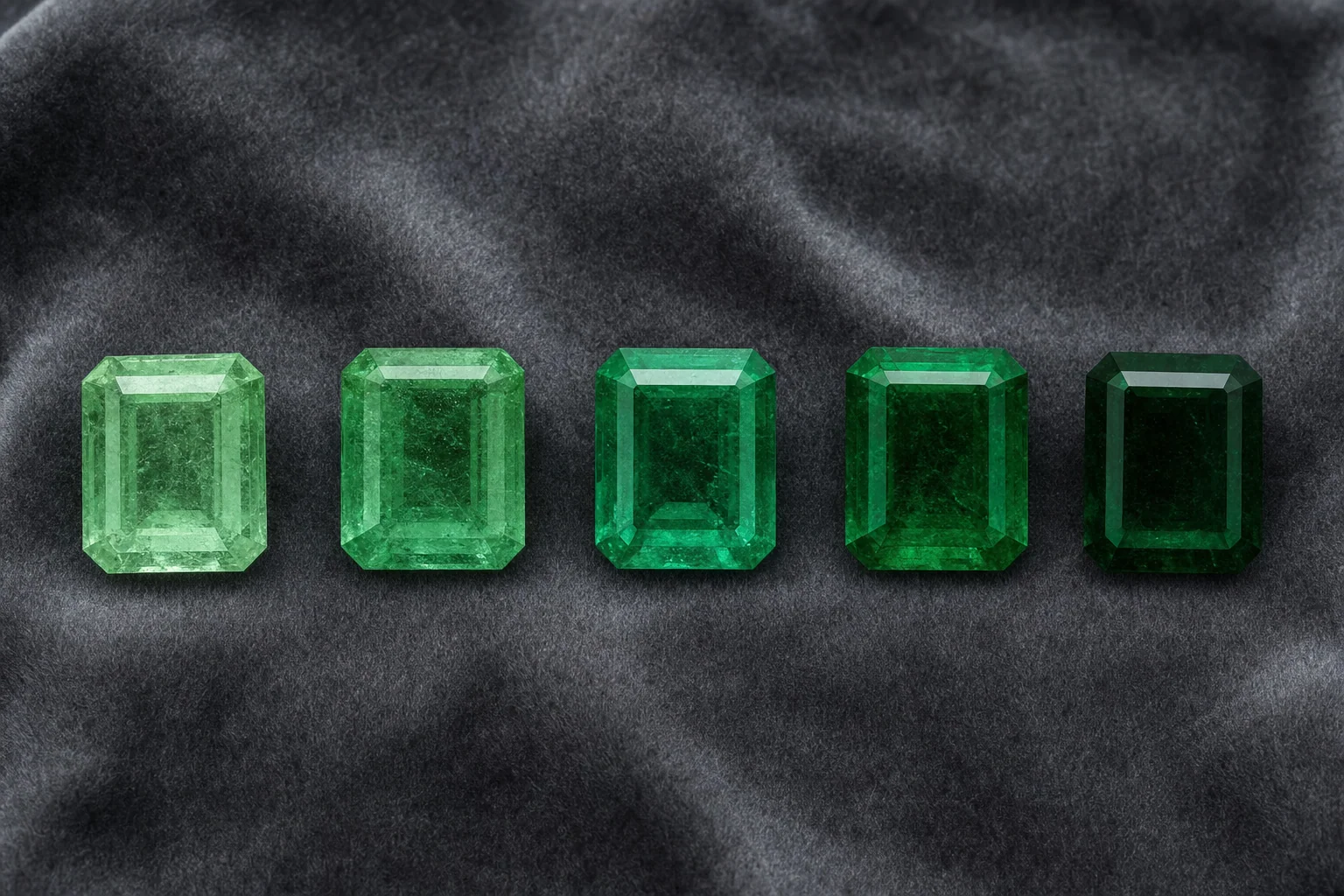
A Colombian emerald is not a single thing. The country has been the world’s most important source of fine emerald since the sixteenth century, and the stones that come out of its various deposits carry recognisably different greens. To a trained gemologist, a Muzo emerald, a Chivor emerald and a Coscuez emerald are as distinct as three sapphires from three different deposits. This guide explains the differences, why they exist, and what they mean to a wearer or collector.
The geography of Colombian emerald
Colombia’s emerald belt runs roughly north–south through the eastern Andes, west of Bogotá. Three mining areas have produced the bulk of historically important stones: Muzo, Chivor and Coscuez. Each lies in a slightly different geological context — different host rock, different trace-element chemistry, different formation conditions — and each leaves a recognisable fingerprint in the emeralds it produces.
Muzo sits in Boyacá department, west of the eastern cordillera. Stones from Muzo characteristically display a warm, slightly yellowish-green — the “grass green” of the trade — with very high saturation. When jewellers speak of “the colour of Colombian emerald,” they are usually describing Muzo material.
Chivor is roughly seventy kilometres northeast of Muzo, also in Boyacá, but in a separate geological context. Chivor emeralds tend to show a cooler, slightly bluish-green — closer to the “spring green” register — with a particular clarity that can rival the best Muzo stones.
Coscuez is closer to Muzo geographically but produces a recognisably distinct material: lighter in tone, often with a particular brilliance and sometimes with a hint of warmth different from Muzo’s. Coscuez has been the most prolific producer historically but yields a wider range of quality, from commercial to genuinely exceptional.
What creates the colour difference
Emerald is the green variety of beryl, coloured by trace amounts of chromium, vanadium and (to a lesser extent) iron. The exact ratio of these elements in a deposit determines where the green sits on the cool-to-warm spectrum:
- More chromium and vanadium, less iron → warmer, more saturated green (Muzo pattern).
- More vanadium, slightly more iron → cooler, slightly bluish green (Chivor pattern).
- Variable ratios depending on the specific vein → wider range (Coscuez pattern).
These trace-element signatures are detectable in gemological laboratories. Modern certification routinely identifies Colombian origin and, when the lab is confident, can specify whether the stone is more likely Muzo, Chivor or Coscuez. The identification is not always definitive — emeralds from one deposit can occasionally overlap with another in trace-element profile — but in most cases the lab can place a Colombian emerald in its most likely origin zone.
Why the distinction matters
To a wearer choosing a Colombian emerald for an engagement ring or a heritage piece, the deposit-level origin matters for three reasons:
Aesthetic preference. Muzo green and Chivor green are recognisably different colours. A wearer who is drawn to the deeper, warmer green will want Muzo material. A wearer who is drawn to the cooler, more transparent green will want Chivor. Neither is objectively better; they are different.
Market value. All else being equal — same carat, same clarity, same cut — a Muzo emerald typically commands a slightly higher price than a Chivor, which in turn commands a higher price than a Coscuez. The differences are not enormous, but they exist and are visible in the certificate.
Provenance documentation. A certificate from a top-tier laboratory that specifies “Colombia, Muzo” carries more documentary weight than one that simply specifies “Colombia.” For collectors, the deeper provenance matters; for engagement-ring wearers, it is a layer of meaning that can be valued or ignored.
What “Colombian emerald” means as a category
Across all three deposits — and the dozens of smaller veins worked across the belt — Colombian emerald shares a set of identifying characteristics that distinguish it from emerald produced in Brazil, Zambia, Ethiopia or Pakistan.
Colombian emeralds tend to have a richer, more saturated green than emeralds from other origins. They typically contain three-phase inclusions (a tiny gas bubble, a liquid pocket and a small crystal, visible under microscope) that are diagnostic of Colombian origin. They often have a softer crystal structure that responds well to fine cutting but is more vulnerable to chipping than other emerald varieties — which is why Colombian emeralds are usually oil-treated to fill surface-reaching fractures (an industry-standard, disclosed practice).
The combination — saturation, three-phase inclusions, characteristic clarity behaviour — makes a fine Colombian emerald instantly recognisable to a trained eye, regardless of the specific deposit.
A working framework for choosing
If you are considering a Colombian emerald, the framework is:
- Start with a top-tier laboratory certificate that specifies origin (Colombia, and if possible the specific deposit).
- Look at the colour family you prefer — warmer Muzo, cooler Chivor, or the lighter Coscuez register.
- Look at the clarity grade — Colombian emeralds are typically Type III (significantly included), but eye-clean stones at the higher end exist and are valued accordingly.
- Confirm the treatment disclosure — fine Colombian emeralds are routinely oil-treated; the certificate should note the type and degree of treatment.
- Consider the cut — Colombian emeralds are often cut in step-cut “emerald cuts” precisely because they show the colour best in that geometry, but cushion, oval and pear cuts can be exceptional too.
The right Colombian emerald, properly documented and well-set, is one of the most extraordinary stones a wearer can choose. It carries five centuries of trade history, three distinct geographic origins, and a green that no other source in the world quite reproduces.
A short reference
- Three principal deposits: Muzo (warm, saturated green), Chivor (cool, bluish green), Coscuez (lighter, variable).
- Diagnostic inclusion: three-phase inclusions (gas + liquid + crystal).
- Standard treatment: cedar oil or modern resin to fill surface-reaching fractures (disclosed).
- Top laboratories: SSEF, Gübelin, AGL for origin determination.
- Typical hardness: 7.5–8 Mohs; durable but brittle — careful daily wear is recommended.
A Colombian emerald is not one green. It is a family of greens, each with its own deposit, its own signature, and its own place in the trade.