
gemstones
Introduction to Diamonds: A Beginner's Field Guide
What a diamond actually is — its chemistry, its origin, its optics, and the handful of properties that explain why a single mineral has held a different conversation with humanity than any other.
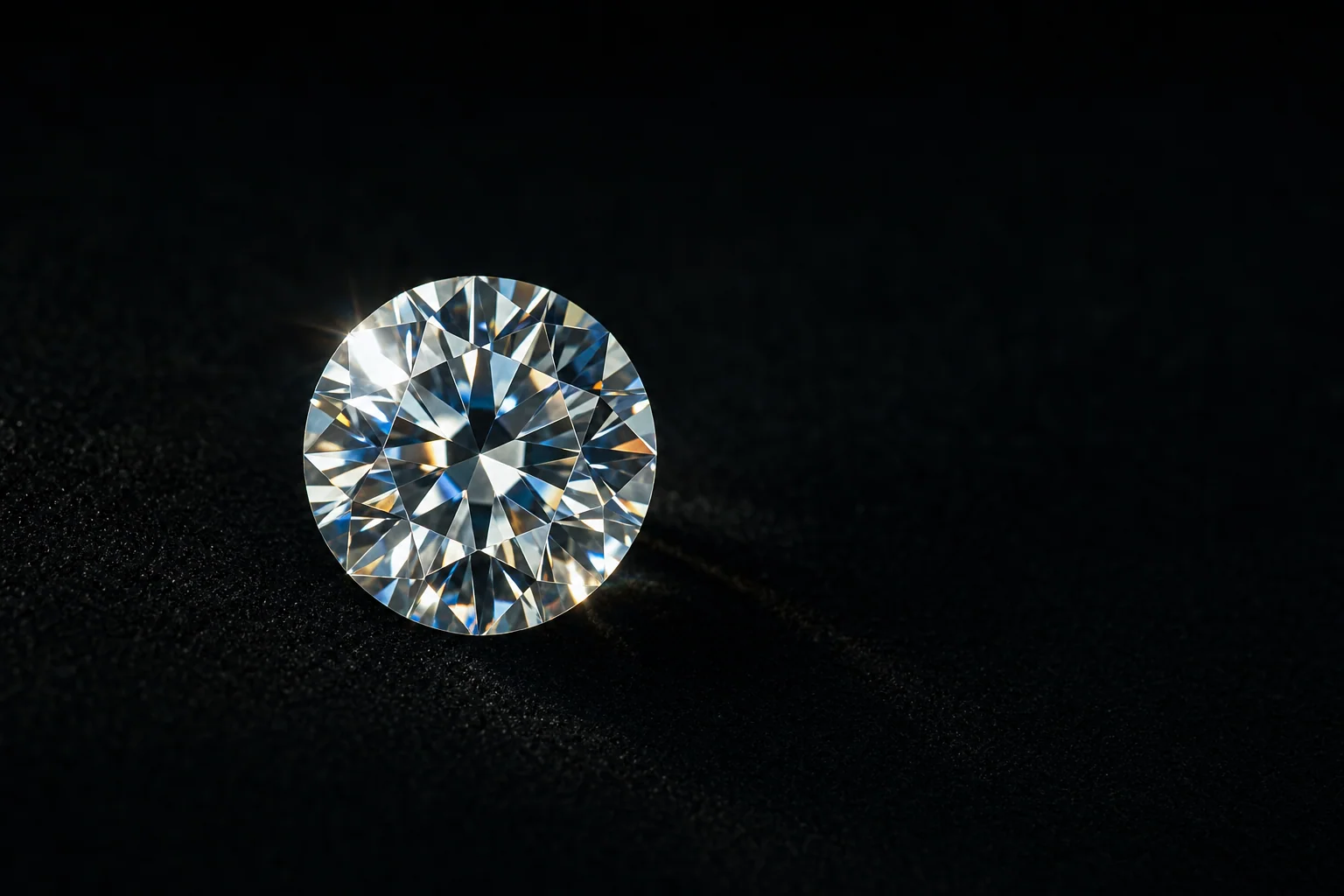
A diamond is, in its plainest description, a piece of carbon. Pure carbon, arranged so that every atom sits at the centre of a tetrahedron whose four corners are also carbon atoms. The arrangement is so dense, so symmetrical, and so resistant to disruption that it produces the hardest naturally occurring material on Earth. This is the entire story, in one sentence. Everything else — the brilliance, the fire, the four-thousand-year-old fascination — follows from that single atomic fact.
This piece is an introduction for someone who has heard the word diamond their whole life without ever quite being told what one is. It is not a buying guide. It is a brief tour of the mineral, the geology, and the optics.
What a diamond is, exactly
A diamond is a crystal of pure carbon — chemical formula C — in the cubic crystal system. The carbon atoms are bonded to four neighbours at the corners of a tetrahedron, and these tetrahedra repeat in three dimensions to fill space. There is no other element in the lattice except, occasionally, trace impurities. Nitrogen (the most common) produces the slight yellow tint visible in many diamonds. Boron produces blue. Radiation damage during the diamond’s underground life can produce green. The structure stays the same; the conversation with light shifts.
The same element, carbon, also makes graphite — the soft, dark material in pencils. The difference is the bonding. Graphite is layered, each layer held to the next by weak forces that slide easily; that is why pencil lead leaves a trace on paper. Diamond is fully three-dimensional bonding, all directions equal; that is why nothing softer than another diamond scratches one.
Where diamonds come from
Diamonds form between 150 and 250 kilometres beneath the surface of the Earth, in the upper mantle, at temperatures around 1,200 degrees Celsius and pressures of 45 to 60 kilobars. Carbon in those conditions arranges itself into the diamond lattice rather than the graphite lattice. The process is slow — most natural diamonds are between one and three billion years old. Some are older than the trees of the species we now mine the diamonds from.
The diamonds do not reach the surface on their own. They are carried up by volcanic eruptions of a specific kind: kimberlite eruptions, which travel almost vertically and at extraordinary speed (the rapid ascent is what prevents the diamonds from converting to graphite as they cross into lower pressures). A kimberlite eruption typically lasts a few hours, deposits a pipe-shaped column of rock from the mantle into the crust, and then cools. Every commercial diamond mine in the world is at the top of one of these pipes, or at an alluvial deposit downstream of one.
The major sources today are Russia, Botswana, Canada, the Democratic Republic of the Congo, Australia, and South Africa. India, the historical source of all the world’s diamonds until the eighteenth century, has been largely worked out — though Golconda, the legendary kingdom whose mines produced the Koh-i-Noor and the Hope, retains its place in the diamond imagination.
How a diamond moves light
The visible behaviour of a diamond — what we ordinarily call its sparkle — is the result of three distinct optical properties, none of which is sparkle as a layperson means it.
Refractive index is the measure of how much light bends as it enters the stone. Diamond’s refractive index is 2.42, which is exceptionally high — higher than corundum (1.77), higher than emerald (1.58), higher than glass (1.50). When light enters a faceted diamond from above, it bends sharply, bounces off the internal facets, and exits back through the crown. This internal bouncing is what produces brilliance — the bright white light that the eye reads as the dominant property of a diamond.
Dispersion is the splitting of white light into spectral colours as it passes through the stone. Diamond’s dispersion (0.044) is high enough that, in a well-cut stone, the eye sees individual flashes of red, yellow, blue, and green as the diamond moves. The trade calls this fire.
Scintillation is the rapid alternation of bright and dark facets as the stone or the viewer moves. It is the product of the facet count and arrangement: a modern round brilliant has 57 or 58 facets, each one acting as a small mirror, and their interplay is what gives the stone its lively, moving quality.
A diamond that “sparkles” well, in the layperson’s sense, is one that combines high brilliance, vivid fire, and crisp scintillation. All three depend more on the cut than on the rough — a brilliant rough cut poorly is dull; an average rough cut superbly comes alive.
What makes one diamond different from another
Within the species, every diamond is described along the four axes covered in The Art and Science of Describing Precious Stones: colour, clarity, cut, carat weight.
Colour in diamonds is graded on the D-to-Z scale developed by the GIA, where D is completely colourless and Z is a noticeable yellow or brown tint. Stones outside the D-Z scale — vivid blues, pinks, greens, and reds — are called fancy colour diamonds, and are valued on a separate, parallel scale.
Clarity in diamonds ranges from FL (flawless under 10x magnification) through VVS, VS, SI, to I (visibly included). The midpoint of the scale — VS to SI — is where most fine engagement-ring diamonds live; eye-clean under normal viewing, with inclusions visible only under magnification.
Cut is graded from Excellent to Poor, taking into account proportions, symmetry, and polish. A well-cut average-clarity stone outperforms a poorly cut high-clarity stone in the only ways the eye cares about: brilliance, fire, scintillation.
Carat weight is precise — two hundred milligrams to the carat — but is, as ever, not the same as face-up size. A one-carat round brilliant runs about 6.5mm across. A one-carat cushion cut might run slightly smaller; a one-carat oval slightly longer.
What a diamond is not
A few clarifications, briefly.
Diamonds are not, in the abstract, rare. Carbon is abundant; the conditions that produce diamonds are not vanishingly uncommon at depth; and modern mining produces hundreds of millions of carats per year. What is rare is the combination of size, colour, clarity, and cut at the top of the market. A flawless three-carat colourless round brilliant is a rare object; a tenth-of-a-carat included stone is not.
Lab-grown diamonds are chemically identical to mined diamonds — same carbon lattice, same hardness, same optical properties. The difference is provenance. Whether that difference matters to a particular wearer is a separate question, and a current debate in the trade.
The phrase “diamonds are forever” was coined in a 1947 De Beers advertising campaign. It is good marketing, and the underlying claim — that the stone is durable — is true. But the cultural permanence of the diamond engagement ring is younger than most of the people reading this.
A short reference
- What it is: pure carbon, cubic crystal system, hardness 10, the hardest natural material.
- Where it forms: 150-250km deep, 1-3 billion years ago, carried up by kimberlite eruptions.
- Why it sparkles: high refractive index (brilliance), high dispersion (fire), 57 facets (scintillation).
- How it’s described: colour D-Z (or fancy), clarity FL-I, cut Excellent-Poor, carat weight to two decimals.
- What’s marketing vs what’s true: the hardness is true; the rarity is contextual; the cultural meaning is recent.
A diamond, properly understood, is geology made portable and light made visible. Everything else is a story the trade has told about it.