
gemstones
Understanding Diamond Colors
From colourless to canary to vivid pink — how the D-to-Z scale works, what the trace elements actually do to the lattice, and why fancy colour diamonds are a different market entirely.
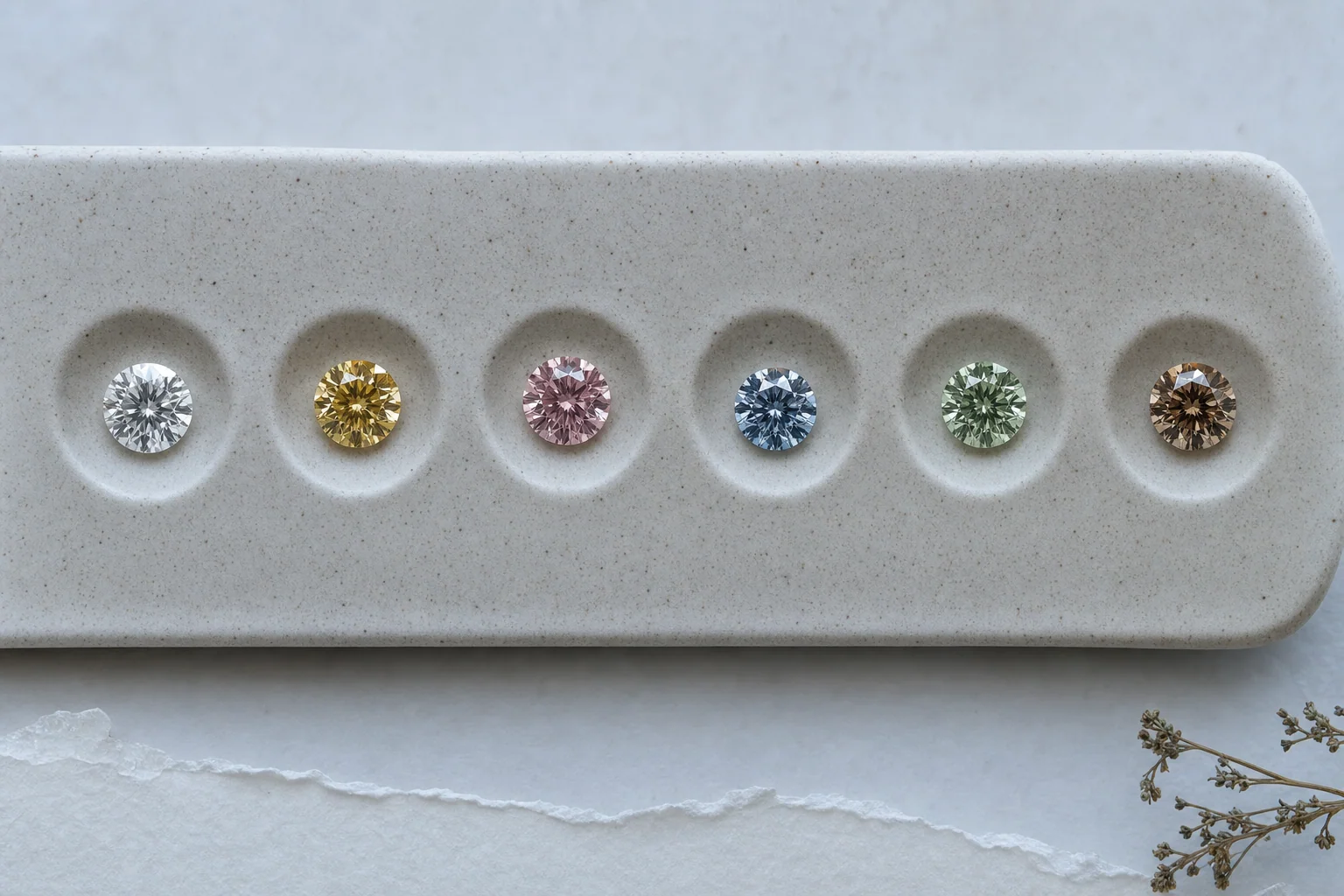
A diamond is, in its purest form, colourless. The same lattice that produces hardness — every carbon atom bonded to four neighbours in a precise tetrahedral arrangement — also produces a transparent crystal that, ideally, lets every wavelength of visible light pass without preference. A truly colourless diamond is a window onto its own internal optics.
In practice, almost every diamond has at least some colour. The colour comes from two sources: trace elements that substituted for carbon during the stone’s billion-year residence in the mantle, and structural defects (radiation damage, lattice distortions) that absorb specific wavelengths. The same set of physical mechanisms produces everything from the slight yellow of a J-graded white diamond to the vivid pink of an Argyle pink to the cobalt-saturated steel of a Hope.
This article explains how the two main systems for describing diamond colour — the D-to-Z scale and the fancy colour vocabulary — actually work, and why the same property reads as a flaw in one half of the market and as the entire point in the other.
The D-to-Z scale: colourless to noticeable
The D-to-Z scale was developed by Richard T. Liddicoat at the GIA in 1953 and is now the global standard for grading the absence of colour in near-colourless to slightly tinted diamonds. The scale runs from D (absolutely colourless) to Z (a noticeable yellow, brown, or grey).
In practice, the scale resolves to five reading bands:
D-F — Colourless. No discernible colour to a trained grader. D is the rarest and most coveted. F is functionally indistinguishable from D to a layperson under normal viewing conditions. These three grades account for a small percentage of gem-quality production and command a significant premium.
G-J — Near colourless. Slight body colour visible to a grader looking at the stone face-down against a white background. Mounted face-up in a setting, G–H grades read as colourless to nearly everyone but a trained gemologist. J begins to show a faint warm tint in larger stones. This is the most commonly chosen band for fine engagement rings — the look of a colourless stone at a meaningfully lower price than D-F.
K-M — Faint. A noticeable warm or yellow tint, visible to the unaided eye in larger stones, especially when set in white metal. Some buyers prefer this range when paired with yellow gold, where the body colour blends with the metal and the stone reads as warmer rather than tinted.
N-R — Very light. The tint is unmistakable. Stones in this range are sometimes recut as small accent stones rather than centre stones.
S-Z — Light. A strong yellow or brown tint, beginning to approach the threshold where the stone would be called a fancy yellow if it crossed into more saturated territory. The lower end of S-Z is sometimes called “cape” yellow in the older trade.
The scale is run by trained graders using a master set of reference diamonds under standardised lighting. A grade of “G” issued by GIA is the same “G” issued in Bangkok or Antwerp because every laboratory uses calibrated masters.
Why D-Z diamonds have any colour at all
The single most common cause of yellow tint in a near-colourless diamond is nitrogen. Carbon and nitrogen are adjacent on the periodic table, and during a diamond’s formation, nitrogen atoms occasionally substitute for carbon atoms in the lattice. Nitrogen absorbs blue and violet wavelengths and lets red, orange, and yellow through — the eye reads the result as a warm tint.
The brown tint, when present, is usually from plastic deformation — lattice distortions caused by stresses during the diamond’s transit from mantle to crust. The distortions create defect centres that absorb blue and yellow wavelengths, leaving brown.
A diamond completely free of nitrogen and free of structural defects is in Type IIa — the rarest of the four chemical types of diamond, accounting for less than 2% of natural diamonds. The Cullinan and the Koh-i-Noor are both Type IIa. Most D-graded stones are Type IIa.
Fancy colour: where the scale ends
When a diamond’s colour passes a certain saturation threshold — beyond the Z grade for yellow/brown, or in any non-yellow direction — it leaves the D-Z scale and enters the fancy colour category. Fancy colour diamonds are graded on a separate axis: not absence-of-colour, but presence-of-colour, with intensity ranging from Faint to Fancy Light, Fancy, Fancy Intense, Fancy Vivid, and Fancy Deep.
The economics invert. In the D-Z range, more colour is less valuable. In the fancy range, more colour (in the rarer hues) is dramatically more valuable. A 2-carat colourless D-grade diamond commands tens of thousands; a 2-carat fancy vivid blue commands millions.
The major fancy colours and the trace elements or defects that produce them:
Yellow diamonds (“canary” at the top end). Produced by aggregated nitrogen impurities. The most common fancy colour, but the vivid pure-yellow grades remain rare. Major sources: South Africa, Australia.
Brown diamonds (“cognac,” “champagne”). Produced by plastic deformation. Once considered industrial-grade only, but now marketed as fine gems, particularly from the Argyle mine in Australia.
Pink diamonds. Produced by plastic deformation of the lattice, exact mechanism still debated. Extremely rare. The Argyle mine in Australia was the source of approximately 90% of the world’s natural pink diamonds; it closed in 2020, and pink prices have risen sharply since.
Blue diamonds. Produced by boron substituted into the lattice. Boron, like nitrogen, sits adjacent to carbon, but absorbs in the red/yellow part of the spectrum, leaving blue. Type IIb diamonds — boron-bearing — are extraordinarily rare. The Hope Diamond, the Oppenheimer Blue, and the Mediterranean Blue are all Type IIb.
Green diamonds. Produced by exposure to natural radiation during the stone’s underground residence. The radiation creates defect centres that absorb red wavelengths and leave green. The Dresden Green is the most famous example. Natural green diamonds are typically only green at the surface; the interior is often colourless or pale. Cutting a green diamond requires preserving the green skin.
Red diamonds. The rarest of all fancy colours. Mechanism: extreme plastic deformation, similar to pink but more intense. The Moussaieff Red is the largest known natural red diamond at 5.11 carats. Fewer than thirty natural red diamonds of meaningful size are known to exist.
Treatment and disclosure
Diamond colour can be modified after mining. The three main treatments:
HPHT (High Pressure High Temperature) can transform certain brown or off-colour diamonds into colourless stones, or into fancy yellows or greens. Treated stones are visually indistinguishable from natural without laboratory analysis.
Irradiation can change the colour of a diamond, often producing blue, green, or yellow tints. Irradiation is detectable by laboratory testing.
Coating is a thin surface film of colour applied to the stone. Easily detected and considered a fraud rather than a treatment when not disclosed.
All treatments must be disclosed on the laboratory report. A fancy colour diamond without explicit “natural colour origin” on its certificate is, by default, treated. The price differential between a natural fancy colour and a treated stone of the same apparent hue is typically an order of magnitude.
How colour interacts with the other three Cs
Colour does not work in isolation. A higher-clarity stone shows colour more clearly (because there are fewer inclusions to scatter the light); a lower-clarity stone often appears slightly more colourful than its grade would suggest. A more shallow cut spreads the colour over a wider face-up area, sometimes making the stone appear lighter in tint than a deeper cut of the same grade. The choice of metal — yellow gold versus platinum versus white gold — visually shifts the apparent colour of the stone by half a grade in either direction.
For an engagement-ring centre stone, the typical recommendation is to choose a colour grade where the stone reads as colourless under normal viewing — G or H for most cuts, F if the budget allows, sometimes J if the stone is paired with yellow gold. The specific call depends on the stone, the setting, and the wearer’s eye.
For a fancy colour piece, the recommendation inverts entirely. The colour is the entire point; clarity becomes secondary; carat weight matters mostly because larger stones show colour more readably. A Fancy Vivid 0.5-carat pink can be a more meaningful object than a 5-carat near-colourless white.
A short reference
- D-to-Z scale: D (colourless) to Z (noticeable tint). G–J is the typical fine-jewellery range.
- Cause of colour in white diamonds: nitrogen (yellow) and plastic deformation (brown).
- Fancy colour: beyond Z, in any direction. Different grading axis; opposite economics.
- Fancy colours and their causes: yellow (nitrogen), brown (deformation), pink (extreme deformation), blue (boron, Type IIb), green (radiation), red (extreme deformation).
- Treatments must be disclosed. Natural colour origin is a major price determinant.
- Practical interaction: colour does not work in isolation — clarity, cut, setting metal, and the wearer’s eye all matter.
Colour, properly understood, is a chemistry story. Everything visible in the stone is a record of what happened during the billion years before it was cut.