
history
The Fascinating History of Emeralds
From Egyptian desert mines to the Mughal court to the Colombian conquest — the five-thousand-year trade history that produced the emerald we know today.
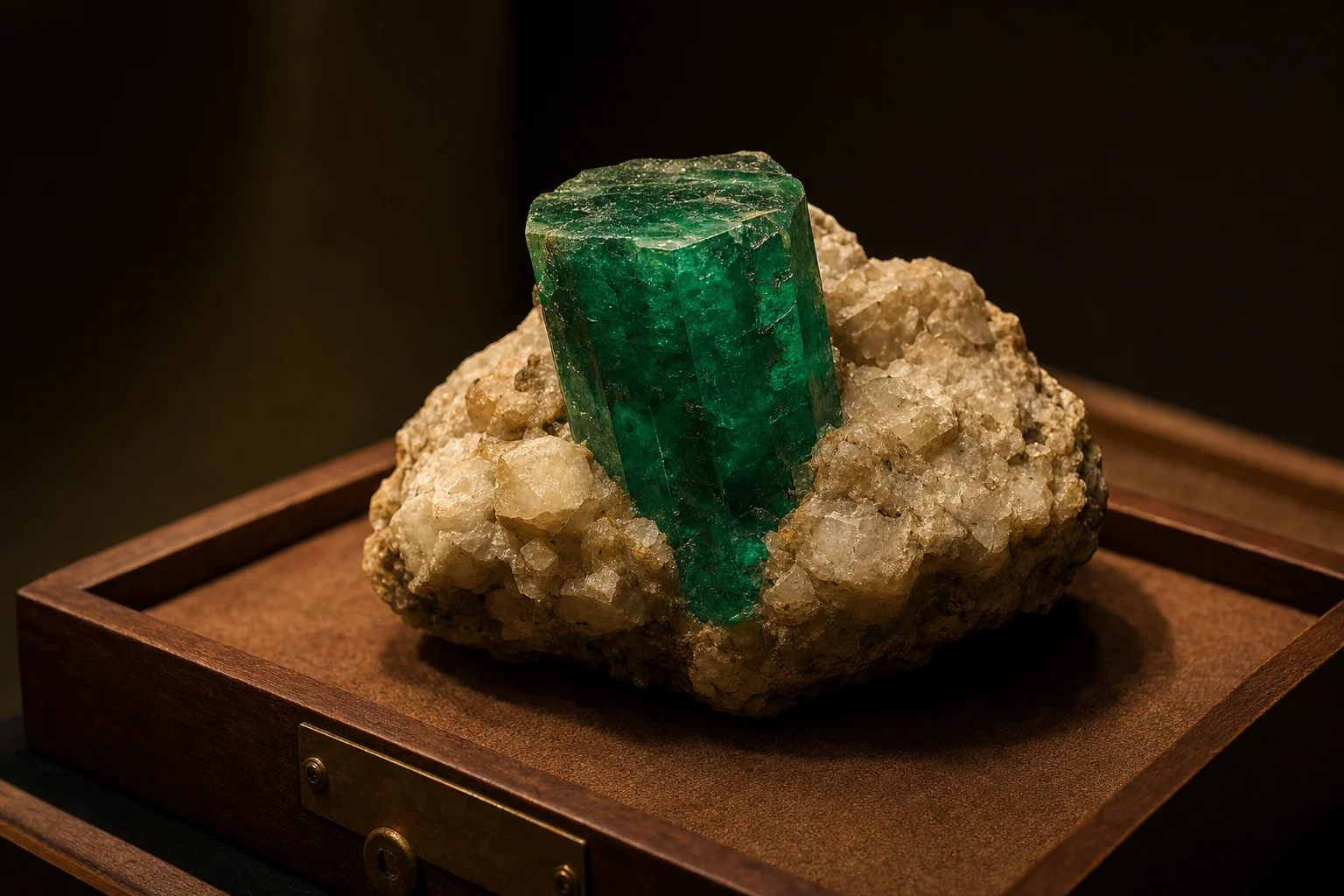
The history of emerald is the history of the first global gemstone. Long before diamond came to dominate the engagement-ring trade in the twentieth century, emerald was the stone that moved between empires — extracted from the Egyptian desert, traded by Romans, prized by Mughal emperors, and finally transformed by the Spanish conquest of South America. This piece walks through the five-thousand-year trade history that produced the emerald we know today.
Egyptian beginnings: the desert mines
The earliest documented emerald mines in the world lie in the eastern Egyptian desert, in the area around Mount Smaragdus (now Gebel Sikait), east of the Nile. Egyptian miners began extracting emerald from these deposits at least as early as 1500 BCE, possibly earlier. The stones were small by later standards — Egyptian emerald is generally heavily included and not particularly transparent — but they were the finest available in the ancient Mediterranean world, and they became the foundation of an entire trade.
The Egyptian pharaohs prized emerald as sacred to Isis and used the stone in funerary contexts as a symbol of eternal life. The famous association with Cleopatra dates to the late Ptolemaic period — Cleopatra is said to have given emerald amulets engraved with her likeness to visiting dignitaries, and to have personally favoured emerald as the gemstone of state.
What the Egyptians could not produce in their own desert deposits, they imported from further afield. Emeralds from the Habachtal deposit in modern Austria reached Egypt through Bronze Age trade networks. The picture of emerald as a Mediterranean-and-beyond traded commodity was already established by 1000 BCE.
Rome and the medieval inheritance
When Rome absorbed Egypt in 30 BCE, the imperial trade in emerald formalised. Roman writers — particularly Pliny the Elder — recorded both the Egyptian and the Scythian (likely from the Urals) sources of emerald available in the Mediterranean. Roman elite wore emerald in rings, pendants, and amulets, and Roman writers attributed to emerald the power to soothe tired eyes (a belief that, as we have seen, has both symbolic and optical justification).
The fall of the Western Roman Empire did not end the trade. Byzantine emperors continued to import emerald from Egypt; medieval European royalty acquired emeralds through the trade routes that ran from the eastern Mediterranean to northern Europe. By the eleventh century, emerald was a standard component of European royal regalia and a stone whose symbolic meanings (truth, love, fidelity) had been canonised in the lapidary literature.
The Mughal connection
In parallel with the European tradition, a separate but interconnected emerald culture developed in the Indo-Persian world. Mughal emperors of the sixteenth and seventeenth centuries — Akbar, Jahangir, Shah Jahan — were extraordinary patrons of emerald, importing the stone from Egypt and (later) from newly-discovered Colombian deposits.
The Mughal court developed lapidary techniques that European workshops never matched. Hand-carving emerald with calligraphy and floral relief at scale required mastery of the stone’s specific brittleness, of carving tools that could remove material without inducing fracture, and of the optical depth that made carved emerald objects work visually. The Mogul Emerald (217.80 carats, with Islamic prayer inscription) is the most famous surviving example.
This Indo-Persian tradition of valued emerald continued through the Persian, Ottoman, and Sikh courts in subsequent centuries, and continues today in the contemporary South Asian market, where emerald maintains an exceptionally strong cultural valuation.
The Spanish conquest and Colombia
The single most consequential event in the history of emerald was the Spanish conquest of the Muisca and Inca peoples in the 1530s. The conquistadors discovered that the Muisca had been mining and trading emerald in the Andean highlands of what is now Colombia for centuries — using emerald in religious and ceremonial contexts, and possessing deposits at Muzo, Chivor and Somondoco that vastly exceeded any source previously known to Old World markets.
The Spanish quickly seized control of the mines and began extracting emerald at industrial scale. Spanish galleons moved Colombian emerald across the Atlantic to Seville and from Seville onward to the markets of Europe, the Middle East, and (most consequentially) Mughal India. Within fifty years of the conquest, Colombian emerald had become the dominant source of fine emerald in the global market, displacing the Egyptian production almost entirely.
The brutality of the Spanish extraction system — particularly its impact on the Muisca population — is part of the same history. The emerald trade that we inherit today began with the violent dispossession of an Andean civilisation. Modern responsible-sourcing practices in Colombian emerald are an attempt to reckon with that legacy.
The nineteenth and twentieth centuries
After the independence of Colombia from Spain in 1819, the emerald trade reorganised under Colombian state and private control. Production fluctuated with political conditions, but Muzo, Chivor and Coscuez continued to be the world’s most important deposits. New finds in Brazil (Bahia, Goiás, Minas Gerais), Zambia (Kafubu), Russia (Urals), and Ethiopia (Shakiso) added supply to the global market but did not displace Colombian as the reference standard.
The twentieth century saw the rise of synthetic emerald — first produced by Carroll Chatham in the 1930s using a flux-growth method, later by hydrothermal methods that produce gem-quality material indistinguishable to the eye from natural stones. Synthetic emerald now competes with natural in the lower-end market; high-quality fine emerald remains exclusively natural, with provenance documented by certificate.
The contemporary market
The contemporary emerald market is structured around four principal origins:
Colombia: the reference standard, with Muzo, Chivor and Coscuez producing the most prestigious fine emeralds. Colombian emerald typically commands the highest per-carat prices.
Zambia: since the 1970s, the second-most-important source. Zambian emerald tends toward a slightly bluer green than Colombian and is generally more included but more durable.
Brazil: producer of large stones, including some of the world’s largest gem-quality emeralds. Brazilian colour tends to be slightly lighter and more variable.
Ethiopia: the newest significant source, emerging in the 2010s, producing some exceptional material that is still finding its market position.
Smaller production continues from Pakistan, Afghanistan, Russia, and other origins. The certificate from a reputable lab specifies the origin when the lab is confident; provenance has become a more important value driver than ever.
What the history means for a wearer today
The wearer who chooses an emerald engagement ring today is joining a five-thousand-year trade that has spanned Egypt, Rome, the Mughal court, pre-Columbian America, conquest Spain, and the contemporary global market. The stone in the ring carries that entire history in compressed form — both the symbolic associations and the material trade chain.
Choosing the origin matters. A Colombian emerald carries different historical weight than an Egyptian one (which would be archaeological, not currently produced) or a Zambian one (which connects to recent trade history rather than ancient symbolic practice). Choosing an emerald with certified responsible sourcing — particularly Colombian emerald from mines operating under modern fair-labour standards — addresses the legacy of the colonial trade.
The certificate documents the contemporary stone. The history documents the chain of meaning the stone enters when the wearer puts it on.
A short reference
- First documented mining: Egyptian eastern desert, c. 1500 BCE.
- First codification of symbolic meaning: Roman lapidary tradition, especially Pliny the Elder.
- Indo-Persian carving tradition: Mughal court, 16th–17th centuries CE.
- Global trade transformation: Spanish conquest of Muisca/Inca, 1530s.
- Modern principal sources: Colombia, Zambia, Brazil, Ethiopia.
- Synthetic competition: since the 1930s (Chatham flux); fine natural remains the prestige market.
An emerald is a stone with a longer documented trade history than almost any other object in the human jewellery tradition. That is part of what the wearer is choosing.