
history
The Emerald: A Symbol of Love in Mythology and Folklore
How emerald earned its place as a stone of love and fidelity across millennia of mythology — Egypt, Rome, the Andes, the Mughal court, and the modern romantic.
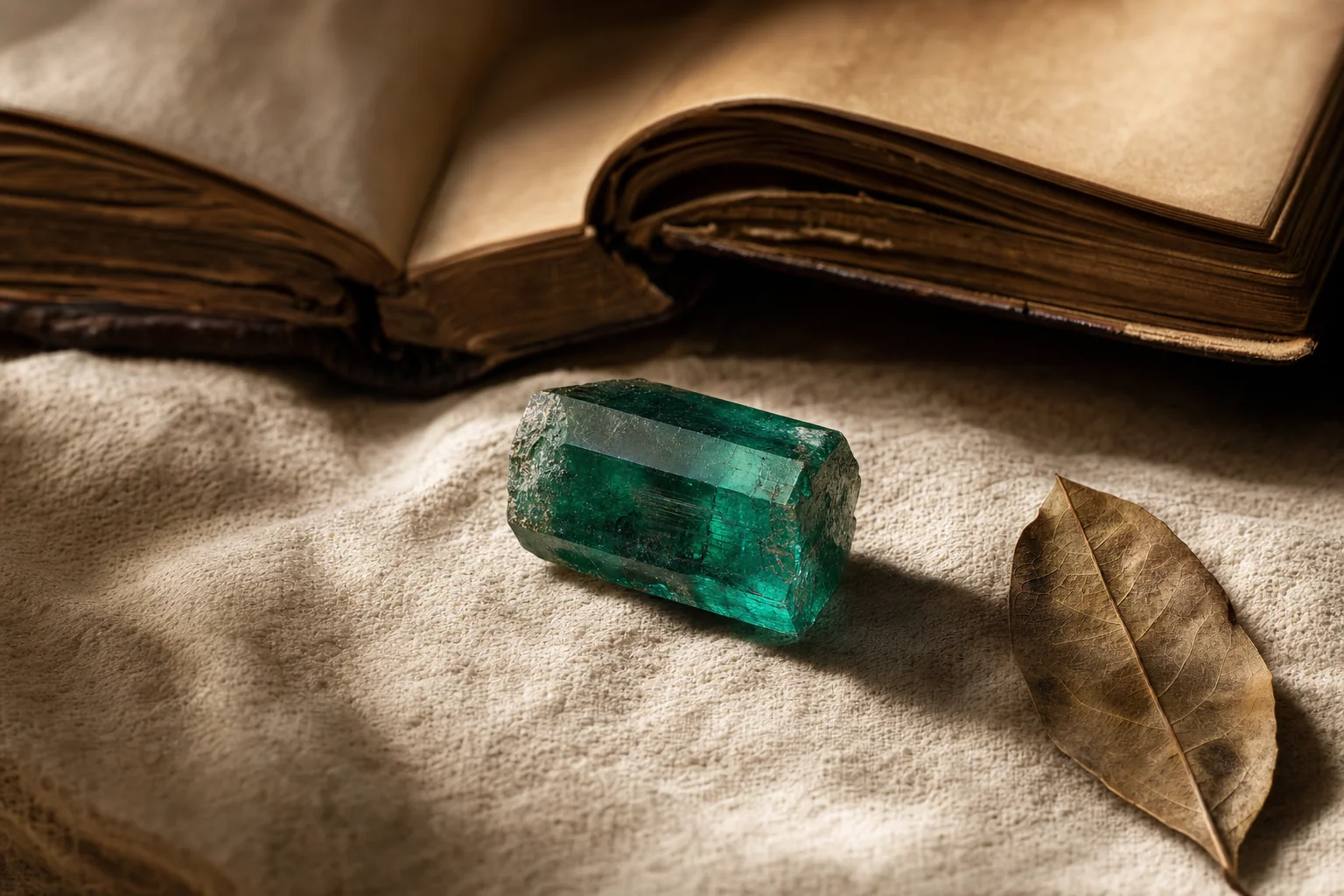
Among the gemstones that have carried symbolic weight across cultures, emerald has accumulated one of the longest and most consistent associations with love. Not the ornamental love of bouquets and Valentine cards — but the durable, sometimes complicated, occasionally divinatory love that older traditions wrote about. This piece walks through how emerald earned that association across Egyptian, Roman, Andean and Mughal traditions, and what the symbolism still means for a wearer today.
Egypt: emerald as Isis
The earliest documented love-symbol associations for emerald come from ancient Egypt. The Egyptians mined emerald in the desert east of the Nile from at least 1500 BCE — the so-called “Cleopatra’s mines” near Mount Smaragdus — and prized the stone as sacred to Isis, goddess of motherhood, fertility, and the power of love that holds families together across death.
Cleopatra herself, according to Roman accounts that may be partly legendary, was a particular devotee of emerald. She wore the stone as personal adornment and gave emeralds engraved with her likeness to visiting dignitaries. The association between emerald and powerful, intelligent feminine love — Cleopatra’s specific brand — became fixed in the Mediterranean imagination through these accounts.
When ancient Egyptians buried their dead, emerald was placed in tombs as a symbol of eternal life and continuing love. The stone’s green colour, evoking the regeneration of vegetation along the Nile, made it the natural choice for a culture preoccupied with the persistence of love beyond death.
Rome: Venus’s green
Roman writers inherited the Egyptian symbolism and refined it. For Romans, emerald was associated with Venus — goddess of love, beauty, and desire — and was considered the most appropriate gemstone for love amulets, betrothal gifts, and tokens between lovers.
The first-century writer Pliny the Elder, whose Natural History is the most important surviving Roman text on gemstones, described emerald as the stone that “soothes the eye” — a phrase that, in Roman usage, also meant soothing the heart. Roman brides sometimes wore emerald as a betrothal token, and Roman husbands gave emeralds to wives during marriage ceremonies as symbols of enduring fidelity.
The connection between green colour and the renewal of love was explicit in Roman thought. Emerald, like the new shoots of spring, represented love that returns and renews — the durable love of long marriages, not the brief passion of youth.
The Andes: emerald as the colour of the gods
In pre-Columbian Andean cultures, particularly the Muisca civilisation in what is now Colombia, emerald held a different but parallel symbolic role. The Muisca considered emerald sacred — the colour of the gods, of fertility, and of the rain that made agriculture possible. Emerald was offered to lakes and to mountain shrines as a gift to the divine.
The Muisca did not, as far as we can document, associate emerald specifically with romantic love in the Mediterranean sense. But they associated it with the deeper fertility that romantic love serves — the productive love that creates families, communities, and continuity of life. The Spanish conquistadors who arrived in the sixteenth century encountered a culture that valued emerald for these reasons, not as a market commodity, and the transition to commercial trade was correspondingly violent.
The fact that the most important emerald deposits in the world (Muzo, Chivor) lie in Muisca territory — and that the modern global trade in emerald began with the Spanish conquest of those mines — gives every Colombian emerald a chain of meaning that pre-dates the conquest by centuries.
The Mughal court: emerald as the love-amulet
In the Indo-Persian world, emerald acquired its most elaborate love symbolism. The Mughal emperors of India — particularly Akbar, Jahangir and Shah Jahan in the sixteenth and seventeenth centuries — were extraordinary patrons of fine emerald, importing Colombian stones in large quantities and carving them into ceremonial objects.
In the Mughal court tradition, emerald was both an amulet for protection in love and a divinatory stone. A husband gave emerald to a wife as a token of fidelity. A wife wore emerald to attract a husband’s continued attention. The stone was believed to reveal infidelity by changing colour — a belief that survived into European folklore, where emerald was sometimes called the “stone of truth” in matters of the heart.
The combination of Mughal carving tradition with Colombian rough material produced some of the most spectacular love-symbol jewels in history. The Mughal Emerald itself (217.80 carats, with an inscription of Islamic prayer) is one example. Many other Mughal emeralds carry inscriptions or motifs related to love, fidelity, and the divine union.
The medieval European inheritance
Medieval European lapidaries — the technical and symbolic catalogues of gemstones — inherited and elaborated these associations. Marbode of Rennes, in the eleventh-century De Lapidibus, attributes to emerald the power to reveal truth in speech, including the truth of a lover’s promises. Albertus Magnus, in the thirteenth century, recommends emerald for those engaged in courtship.
By the fourteenth century, emerald was a standard betrothal stone in European royal courts. The future Catherine the Great of Russia received emeralds as engagement gifts; Mary Queen of Scots possessed several. The English crown jewels include emeralds with deep romantic provenance.
The persistence of emerald as a love symbol through European royal practice helped fix the association in the European cultural memory, from which it descended into the modern engagement-ring tradition.
The modern romantic
For a contemporary wearer, emerald carries this accumulated symbolism into the present. An emerald engagement ring, an emerald anniversary gift, an emerald passed down through generations — each gesture activates a chain of meaning that runs through Egypt, Rome, the Andes, the Mughal court, medieval Europe, and the modern romantic imagination.
The stone does not require the wearer to believe in any specific tradition. The accumulated weight of millennia of meaning is available to anyone who chooses an emerald, regardless of whether they explicitly invoke Isis, Venus, the Muisca, or the Mughal emperors. The green colour and the symbolic resonance work whether or not the wearer reads the history.
But for the wearer who does read the history, an emerald becomes a denser object. It is not just a stone the wearer happens to like. It is a stone that has been carrying love-meaning for over three thousand years, and the wearer has now joined the chain.
A short reference
- Egyptian association: Isis, motherhood, eternal love beyond death.
- Roman association: Venus, betrothal, marriage fidelity.
- Muisca/Andean association: fertility, divine renewal, generational continuity.
- Mughal association: love-amulet, divination of fidelity, ceremonial token.
- Medieval European inheritance: betrothal stone, “stone of truth” in matters of the heart.
- Modern wearer: the accumulated weight of all of the above, available without belief required.
A wearer who chooses emerald is joining a conversation that began before the pyramids were built and has not paused since.