
history
The History of Sapphires
From ancient Persia's "piece of the sky" to Princess Diana's engagement ring — how the blue corundum has carried the same set of meanings across thirty centuries.
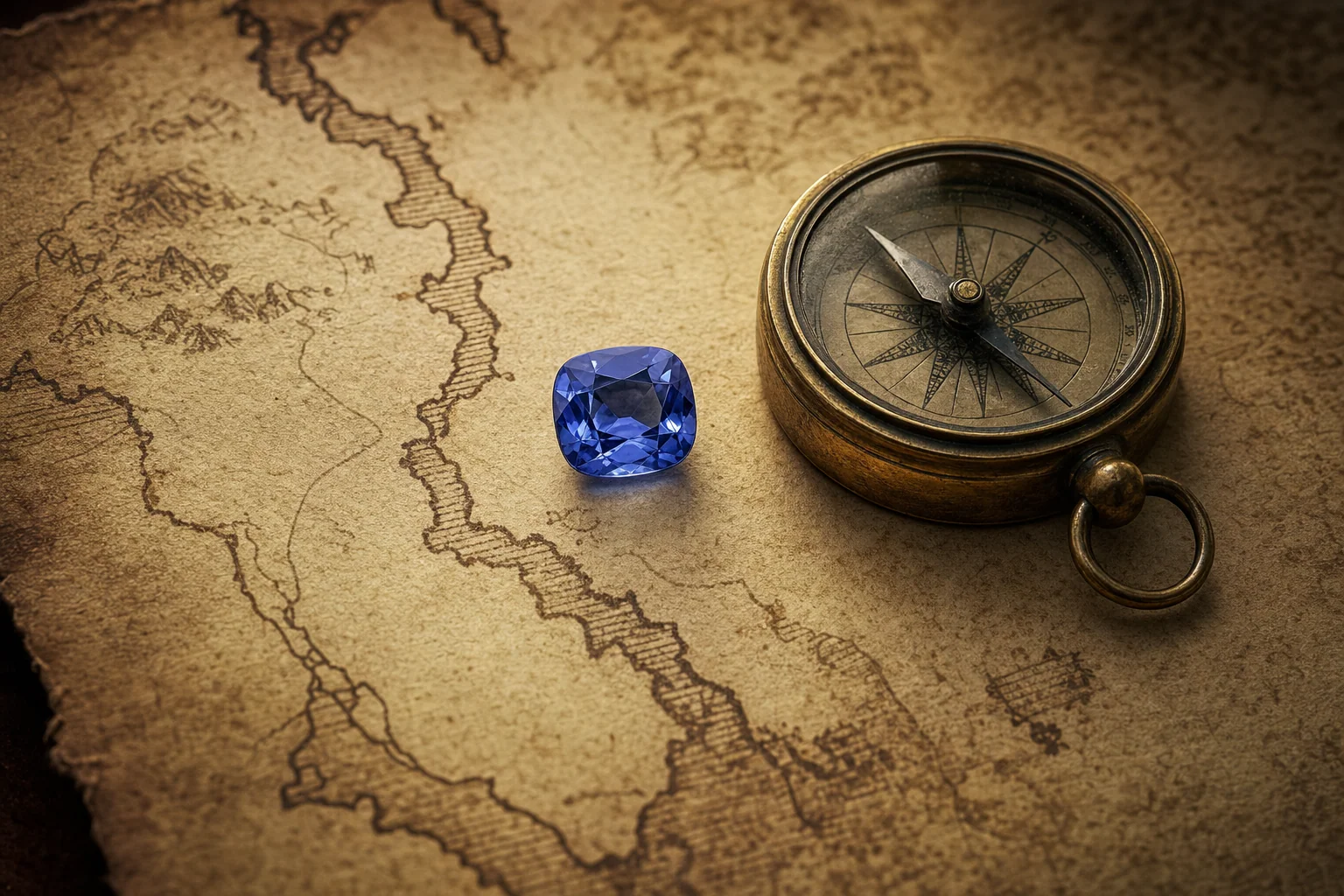
The sapphire has been carrying meaning, in one civilisation or another, for at least three thousand years. The meaning has been unusually stable. Across Persian, Greek, Roman, medieval European, and modern Western traditions, the sapphire has been read as the stone of wisdom, truth, divine favour, and royal authority. The cultures shifted; the meaning held.
This article follows the sapphire’s trajectory through history, drawing on the standard reference work — Richard W. Hughes’ Ruby & Sapphire: A Gemologist’s Guide, which remains the most thorough single book on the corundum family. It is a brief tour, not an exhaustive account.
Ancient origins: the piece of the sky
The earliest known references to sapphires are in Persian sources from around 800 BCE. The Persians believed the earth rested on a giant sapphire, and that the colour of the sky was a reflection of this underlying stone. To wear a sapphire was, in this cosmology, to wear a fragment of the foundation of the world.
The word sapphire derives from the Greek sappheiros, which appears in classical sources from the fifth century BCE onward. The Greek word itself probably derives from the Hebrew sappir, which appears in the Old Testament as one of the stones in the breastplate of Aaron (Exodus 28:18). It is worth noting, however, that the ancient term sappheiros did not refer specifically to blue corundum — most scholars believe the classical “sapphire” was actually lapis lazuli, the deep blue silicate. The transition from lapis to corundum as the referent of sapphire happened gradually in the medieval period, as the mineralogy of the Greek and Hebrew sources was reinterpreted under Arabic and later European traders’ knowledge of the corundum trade.
In ancient Persia and India, sapphires were associated with protection from harm and envy. Worn as amulets, they were thought to repel poison, calm internal disorders, and ward off the evil eye. The protective association would persist in European folklore through the nineteenth century.
The medieval period: ecclesiastical and royal
The medieval European tradition consolidated the sapphire as the stone of heaven and church. Pope Innocent III, in the early thirteenth century, decreed that bishops should wear sapphire rings on the right hand — the anulus pontificalis — as a symbol of their connection to divine wisdom and their authority to bind and loose. The papal sapphire was a fixture of European episcopal regalia for centuries.
The sapphire was simultaneously the favourite stone of European royalty. The deep blue, associated both with the sky and with the Virgin Mary, marked the wearer as connected to a higher order than the temporal. Royal sceptres, crowns, and orders of chivalry incorporated sapphires almost universally. The British Crown Jewels alone contain several historically significant sapphires, including the Stuart Sapphire (mounted in the back of the Imperial State Crown) and St Edward’s Sapphire (set in the cross at the top of the same crown). The latter is said to have been worn in the ring of Edward the Confessor in the eleventh century and to have remained continuously in royal possession ever since.
The medieval lapidaries, in addition to the religious symbolism, recorded a long list of practical claims for sapphires: that they cured eye diseases, that they soothed inflammations, that they revealed treachery, that they preserved chastity. Some of these claims were sufficiently persistent that they appeared in pharmacological texts as late as the seventeenth century.
The Kashmir discovery
The single most important event in the modern history of sapphires is the discovery of the Kashmir deposit in 1880. A landslide in the remote high-altitude valley of Padar, in what is now Indian-administered Kashmir, exposed a corundum deposit that turned out to produce the finest blue sapphires the trade had ever seen — a deep, slightly violet, velvety blue that came to be called cornflower blue.
The Kashmir deposit was worked intensively by the local Maharaja and his concessionaires from 1882 to roughly 1887, after which the easily accessible material was largely exhausted. Sporadic production continued through the early twentieth century, and a few stones have been recovered in modern times under Indian government auspices, but the deposit is essentially historical. A Kashmir-origin sapphire today, certified by laboratory analysis to that source, commands prices an order of magnitude above sapphires of equivalent appearance from any other source.
The Kashmir story is, in a way, the founding story of modern sapphire-as-luxury: a brief geological window producing a small population of extraordinary stones that have, ever since, set the standard against which other sapphires are measured. The trade speaks of Kashmir-quality as a descriptive term even when the stone in question is from Burma, Sri Lanka, or Madagascar.
The Burmese and Ceylonese traditions
In parallel with the Kashmir story, two other source regions have shaped the modern sapphire trade.
Burma (Myanmar) — the Mogok region — produces sapphires alongside its more famous rubies. Burmese sapphires are typically a strong royal blue, sometimes approaching the velvety quality of Kashmir but usually with slightly different tonal characteristics. They have been mined for at least eight hundred years; the modern industry was systematised under the British in the late nineteenth century and has continued, with various interruptions due to political circumstances, into the present.
Ceylon (Sri Lanka) — the Ratnapura region — has been producing sapphires for at least two thousand five hundred years. Ceylon sapphires are typically lighter than Burmese or Kashmir stones, with a brilliant cornflower or sky-blue character. They are also the source of most of the world’s fancy sapphires — the yellows, pinks, oranges, and color-change stones. The padparadscha — the orange-pink variety, the most coveted of all sapphire colours — is found almost exclusively in Sri Lanka.
The modern major source, Madagascar, emerged in the 1990s. Madagascar sapphires can match Sri Lankan and even Burmese material at the high end, and they have become an important supply for the contemporary trade. Origin determination by laboratory remains essential, as the same hue from different sources commands very different prices.
The Diana sapphire — and Catherine’s
The single most-photographed sapphire of the twentieth century is the Diana sapphire — the 12-carat oval blue Ceylon sapphire surrounded by fourteen diamonds, given by Prince Charles to Lady Diana Spencer at their engagement in 1981. The ring was unusual in its time precisely because it was not commissioned bespoke — it was a stock piece from the royal jeweller’s catalogue, and Diana selected it from a tray of options. The choice broke with the tradition of unique royal commissions and made the design accessible to commoners in a way that few royal jewels had ever been.
Following Diana’s death, the ring passed to her son Prince William, who gave it to Catherine Middleton at their engagement in 2010. It is now worn by the Princess of Wales and has become one of the most influential single pieces of jewellery in the modern engagement-ring market — sapphire-centre rings rose substantially in popularity after Catherine began wearing it, and the design has been widely imitated.
The Diana ring is, in many ways, the modern continuation of the sapphire’s ancient role as the stone of royal betrothal — a tradition that runs continuously from the medieval European courts through Queen Victoria’s sapphire jewellery to the present.
The mystical inheritance
Across all of this history, the symbolic associations of the sapphire have remained extraordinarily stable. The stone has been the gem of:
- Wisdom and clear thinking — from Persian cosmology through medieval lapidaries through modern New Age literature.
- Truth and faithfulness — given as a betrothal stone partly because it was believed to detect or prevent infidelity.
- Divine favour and spiritual insight — the gem of bishops, the gem of monks, the gem of meditation.
- Royal authority — present in nearly every European crown of any consequence.
- Protection from envy and harm — the original protective amulet across multiple cultures.
The optical properties — deep blue, calm, internally luminous without the flash of a diamond — have made the stone read as wise rather than showy in nearly every culture that has known it. The hardness has made it durable enough to outlast the wearer. The colour, sitting close to the colour of the sky and the sea and the deep night, has read as connected to a larger order than the everyday. Three thousand years of consistent reading is a great deal.
A short reference
- Etymology: Greek sappheiros, probably from Hebrew sappir — originally lapis lazuli, gradually reassigned to blue corundum.
- Ancient association: the foundation of the sky, protection from harm.
- Medieval: the gem of bishops and royalty; symbolic of heaven and divine wisdom.
- 1880: Kashmir deposit discovered. Sets the modern standard for finest blue.
- Other major sources: Burma (Mogok), Sri Lanka (Ratnapura), Madagascar.
- 1981 and 2010: the Diana / Catherine sapphire ring — modern continuation of the royal-betrothal tradition.
- Symbolic stability: wisdom, truth, faithfulness, divine favour. Three millennia, one set of meanings.
The sapphire is, perhaps more than any other gem, a stone that the centuries have agreed about.