
history
The History of Diamonds
From Golconda riverbeds to the Kimberley rush to lab-grown synthesis — how a hard piece of carbon became a global symbol, and what each century added to the meaning.
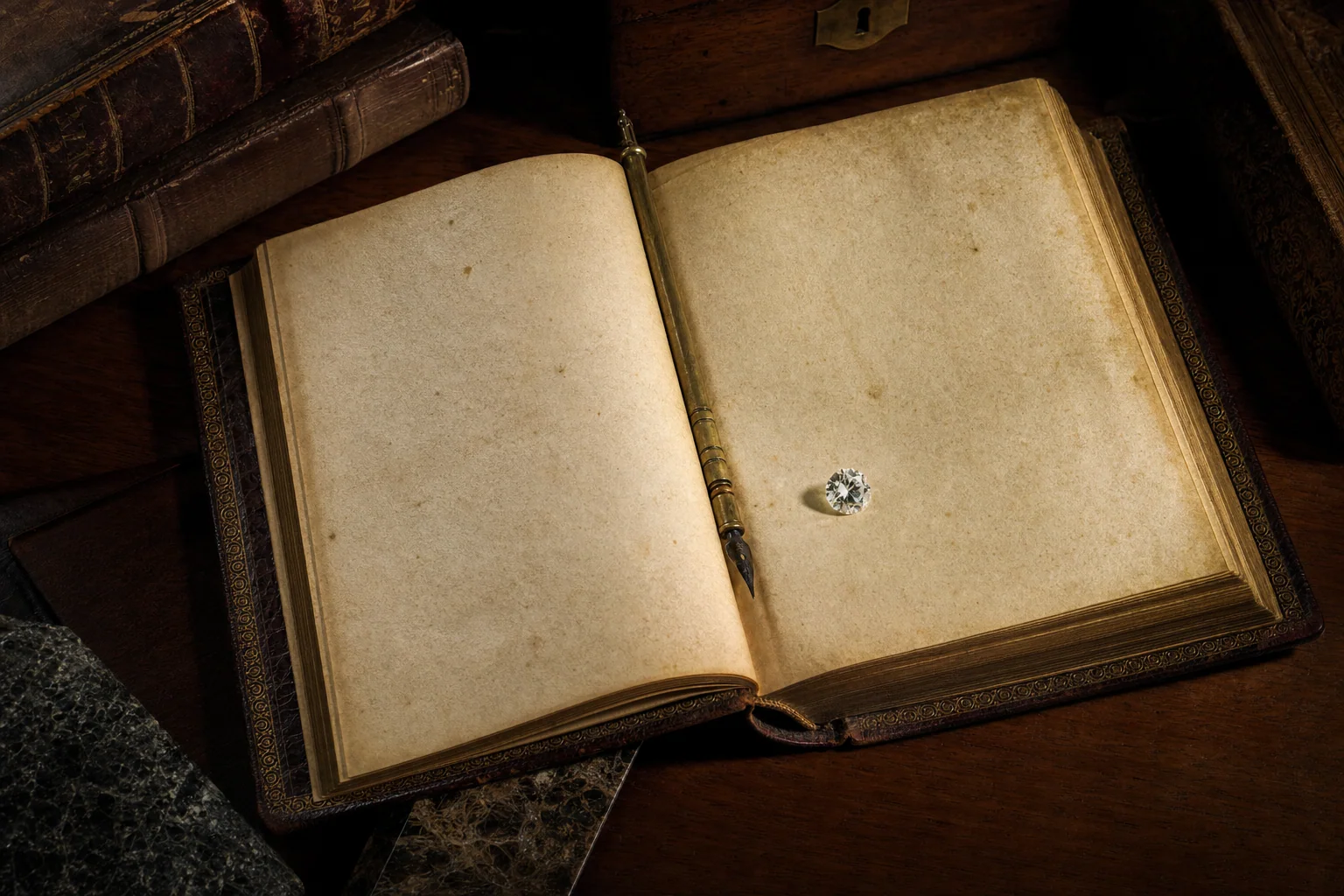
The diamond has been carrying meaning, in one culture or another, for at least 2,500 years. Its meaning has not been stable. At various points the same stone has been a weapon’s edge, a king’s amulet, a token of an unwritten engagement, a unit of speculation, an instrument of empire, and a marketing campaign. Reading the diamond’s history is reading a long argument about what a hard, transparent piece of carbon is for.
This article walks through the major chapters of that argument, drawing on the standard reference works — Hertz’s History of Diamonds, Francesca Cartier Brickell’s Diamonds: The History of the World’s Most Coveted Gem, and the contemporary literature on the De Beers-era diamond market. It is a sketch, not an encyclopedia.
Antiquity: diamonds as edges and amulets
The earliest known diamonds were mined from the alluvial deposits of the Krishna and Godavari rivers in the Indian Deccan, beginning around the fourth century BCE. India was the only meaningful source of diamonds for the world until roughly 1725. The stones, recovered as small octahedra and irregular fragments from the gravel, were valued first for their hardness — they could engrave other gems — and second for their internal brilliance, which was thought to be a containment of fire or lightning.
The Sanskrit word vajra names both diamond and the thunderbolt of the god Indra. The same hardness that made the stone useful as a tool made it desirable as a talisman: a piece of vajra worn on the body was believed to confer invulnerability, ward off evil spirits, and protect against poison. Roman writers — Pliny the Elder among them — repeated these claims as they passed westward along the Silk Road, and added their own: that diamond fragments embedded in armour would deflect blows, that a diamond placed in the mouth of a corpse would prevent decay.
The stones reaching Rome and later medieval Europe were not faceted. They were either rough octahedral crystals worn whole, or rough surfaces lightly polished. The brilliance that the modern eye associates with a diamond is largely the product of cutting techniques that did not exist before the fifteenth century.
The Renaissance: the first cuts
The diamond’s transformation from amulet to ornament begins in the fifteenth century, with the development of techniques for cutting and polishing the stone using diamond dust on a rotating wheel. The earliest cut, the point cut, simply polished the natural octahedron’s faces. The table cut followed, flattening one of the points to create a small table facet on top. By the sixteenth century the rose cut had emerged — a domed crown of triangular facets meeting at a point — and during the seventeenth century the brilliant cut was developed, with a flat table and a circular outline arranged to maximise the return of light.
Each new cut increased what the stone could do optically, and each shifted the social meaning of the stone. A point-cut diamond was an inert object, valued for its rarity. A brilliant-cut diamond was an active object, valued for what it did to light. The transition was gradual, and the older cuts persisted in inherited jewellery for centuries — the dim flash of a rose cut still distinguishes Victorian and Edwardian pieces from modern ones.
In 1477, Archduke Maximilian of Austria gave a diamond ring to Mary of Burgundy. This is the earliest documented diamond engagement ring; how widespread the practice was outside of royalty is unclear, but the gesture is regularly cited as the founding moment of the modern tradition. The ring itself was modest by later standards — a thin gold band with small uncut diamonds arranged in the shape of an M.
The eighteenth century: Brazil
For two thousand years, India was the world’s only meaningful source of diamonds. This changed in 1725, when alluvial diamonds were discovered in the Minas Gerais region of Brazil. The Portuguese crown declared a royal monopoly almost immediately, and by mid-century Brazil was producing more diamonds than India had in any decade of its history.
The Brazilian supply changed the trade in two ways. It lowered the unit price of diamonds for the first time in their history — there had never been enough Indian production to flood the market, but Brazil could. And it shifted the centre of gravity of the cutting industry from Antwerp to Amsterdam, as the Dutch developed faster and more efficient cutting techniques to handle the new volume.
The eighteenth century also saw the codification of much of what is now considered diamond etiquette: the diamond as a gift between men of high status, the diamond as part of the parure worn by noblewomen at court, the diamond as a politically significant object that could be loaned, displayed, and inventoried.
The nineteenth century: Kimberley and De Beers
In 1866, a child playing on a farm near the Orange River in South Africa picked up a transparent pebble. It was a 21.25-carat diamond, the first significant diamond discovered in southern Africa. Within five years, the area around the small settlement of Kimberley had become the largest diamond-mining operation in human history. The Kimberley Rush attracted tens of thousands of miners, and by the late 1870s the South African production was overwhelming everything that had come before.
In 1888, an Englishman named Cecil Rhodes consolidated the major Kimberley mines into a single company, De Beers Consolidated Mines. The strategy was explicit: control the supply so that the price would not collapse. For most of the twentieth century, De Beers was the world’s diamond market — the company controlled mining, distribution, and (later) marketing across most of the global trade. Diamond prices remained extraordinarily stable for decades, a result not of natural scarcity but of deliberate market management.
The phrase that came to define the twentieth-century diamond was written in 1947, when N. W. Ayer & Son created the campaign A Diamond Is Forever for De Beers. Within fifteen years, the diamond engagement ring had become a near-universal expectation in the United States, and within thirty years, globally. The campaign is often cited as the single most successful advertising campaign in history, and its imprint on the meaning of the diamond is still legible today.
The twentieth and twenty-first centuries: ethics, lab-grown, and the question of meaning
Three developments have reshaped the diamond market since the 1990s.
The first was the recognition of conflict diamonds — stones mined in war zones and sold to fund armed groups, particularly in Sierra Leone, Liberia, and Angola. The 2003 Kimberley Process, a certification scheme requiring rough diamonds to be accompanied by a conflict-free certificate when crossing borders, was the trade’s response. The Process is imperfect — its definition of “conflict” is narrow, and its enforcement has been uneven — but it represents the first time the industry systematically engaged with the question of where its stones came from. We discuss this in more depth in the certification stack.
The second was the erosion of the De Beers monopoly. Russia, Australia, and Canada began producing significant quantities of diamonds in the late twentieth century, none of them sold through De Beers’ Central Selling Organisation. By 2000, De Beers controlled less than half the world’s rough production, and by 2010, less than a third. The cartel structure that had stabilised diamond prices for a century was effectively over.
The third was the rise of lab-grown diamonds — diamonds produced by High Pressure High Temperature (HPHT) and Chemical Vapour Deposition (CVD) techniques, chemically identical to mined diamonds and visually indistinguishable to the naked eye. By 2020, lab-grown stones had moved from industrial use into the gem market, and by 2024 they had begun to put serious downward pressure on the prices of mined stones in the smaller sizes.
What lab-grown does to the meaning of the diamond is a question the trade is still resolving. A mined diamond carries a billion-year geological history; a lab-grown diamond carries a few weeks of engineering. The optical properties are identical. The provenance is not.
A short reference
- 2,500 years ago: first mined in India, valued for hardness and as a talisman.
- 1477: the first documented diamond engagement ring (Maximilian to Mary of Burgundy).
- 1725: Brazilian discovery breaks India’s two-thousand-year monopoly.
- 1866-1888: Kimberley discovery, De Beers consolidation, the modern industry begins.
- 1947: A Diamond Is Forever — the campaign that built the modern engagement-ring tradition.
- 2003: Kimberley Process — first systematic attempt to address conflict diamonds.
- 2020s: lab-grown stones reshape the lower end of the market; provenance becomes the new differentiation.
A diamond, today, carries every layer of this history at once. The hardness is the same; the meaning is whatever the wearer can defend.