
history
The Most Important Emerald in History: The Mogul Emerald
A 217-carat carved emerald that travelled from Colombia to the Mughal court, vanished for centuries, and resurfaced at auction — and what it tells us about the gemstone trade across four continents.
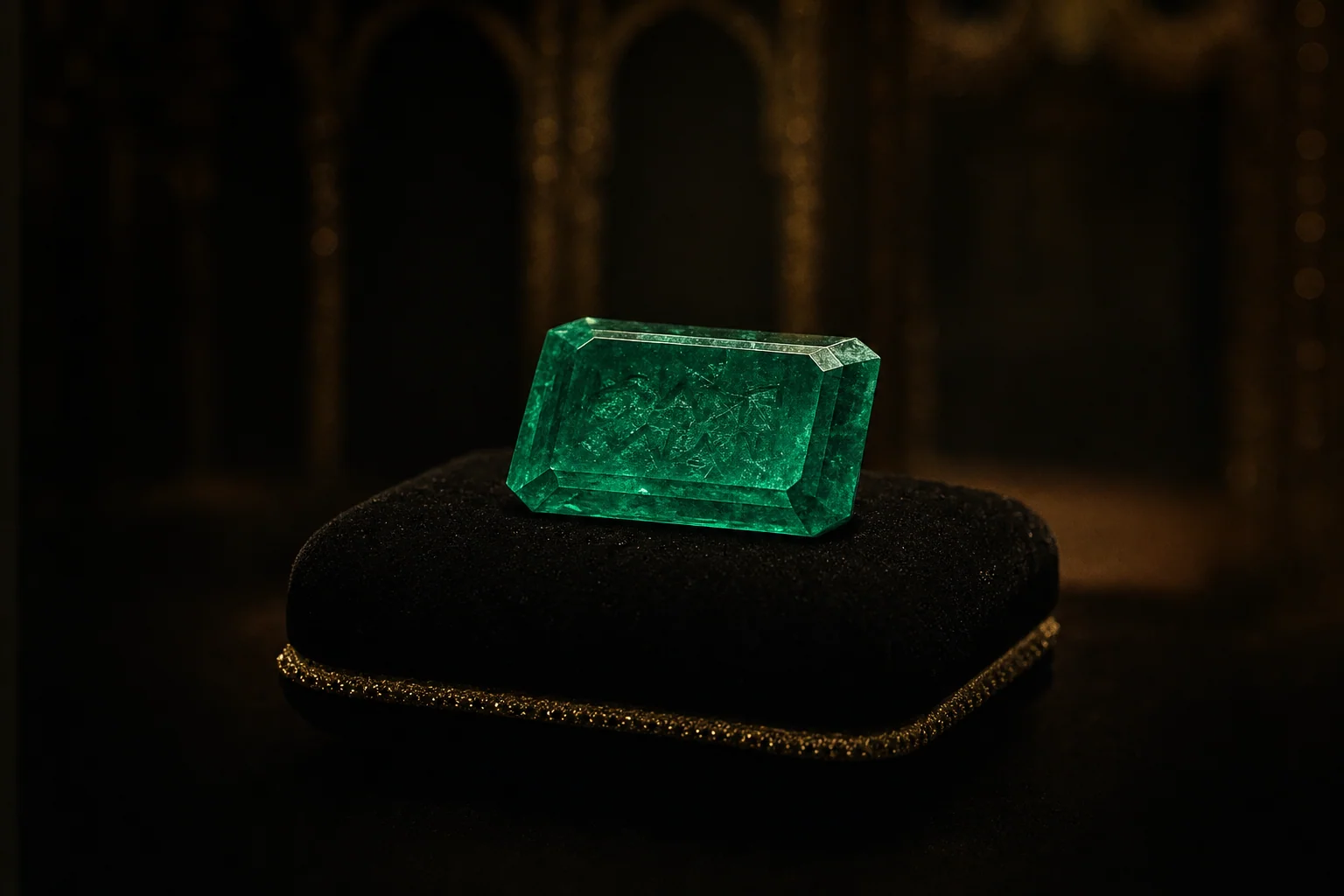
Among emeralds that have left a measurable mark on history, the Mogul Emerald is the most quietly extraordinary. It is not the largest emerald ever mined — far larger uncut stones exist. It is not the most expensive emerald ever sold at auction — that title has changed hands several times in the past decade. What makes the Mogul Emerald unique is the route it travelled: from a Colombian mine in the seventeenth century, across the Atlantic, to the court of the Mughal emperors in India, where artisans transformed it into one of the most precisely carved hard-stones in the world.
This piece follows the stone’s biography, what it tells us about the gemstone trade in the early modern period, and why it still commands attention every time it surfaces.
The object
The Mogul Emerald is a single carved stone weighing approximately 217.80 carats, roughly the size of a small palm. On one of its faces, an inscription in Arabic naskh script carries a passage of Islamic prayer — an invocation seeking protection. The opposite face is carved with delicate floral patterns characteristic of Mughal decorative art. Two small drill holes near the edges suggest the stone was once set into a textile or strung on a cord, likely to be worn directly against the body.
The carving is exceptional. Hand-carving an emerald is technically difficult because the stone, while hard (7.5–8 on the Mohs scale), is famously brittle — internal fractures and inclusions make it prone to splitting under pressure. A 217-carat emerald carved with both calligraphy and floral relief without damage represents weeks if not months of careful work by a master lapidary, with no margin for error.
How it got to India
Colombian emeralds reached India through the Spanish trade networks that emerged after the conquest of the Muzo and Chivor mines in the 1530s. Spanish merchants moved emeralds eastward — across the Atlantic to Seville, around the Cape, and into the Indian Ocean trade routes that connected European traders to the courts of South Asia.
The Mughal court was the dominant market. Mughal emperors, particularly Akbar, Jahangir, and Shah Jahan, were extraordinary patrons of gemstone art. Colombian emeralds — larger, more saturated, and more transparent than the Egyptian or Austrian emeralds previously available to Indian artisans — quickly became status symbols at court. The Mughal emperors collected them by the hundreds.
The Mogul Emerald was almost certainly carved in the seventeenth century, during the reign of one of these emperors. The combination of Islamic prayer text and floral decoration places it firmly in the courtly aesthetic of the period.
How it disappeared, and reappeared
The seventeenth-century history of the Mogul Empire is also the history of the great wars and lootings that ended it. The 1739 sack of Delhi by Nader Shah of Persia stripped the imperial treasury of jewels accumulated across generations. Many of those jewels passed through Persia, then through other markets — some destroyed, some recut, some preserved in private collections that did not surface for a century or more.
The Mogul Emerald disappears from the historical record after the Mughal period. It reappears in twentieth-century Europe, in the hands of private collectors whose acquisition stories remain incompletely documented. In 2001, Christie’s auctioned the stone in London. It sold for approximately US$2.2 million — at the time a record price for a single emerald — to a private buyer whose identity remains undisclosed.
It has not surfaced publicly since.
Why it matters
The Mogul Emerald is significant beyond its size or its price. It is a single object that documents the first global trade in fine gemstones — Colombian rough, crossed two oceans, carved in Mughal India, looted, scattered across Persia, recovered in Europe, sold at auction in London, currently owned somewhere private. Few other objects in the gemstone world carry that complete a biography.
It also documents the technical sophistication of seventeenth-century lapidary art in a way that contemporary stones rarely do. The Mughal carvers worked without electrical tools, without modern abrasives, without the optical equipment that would later make precision possible. A 217-carat emerald carved with both calligraphy and floral relief, retained intact across four hundred years, is a testament to a craft tradition that we cannot fully reconstruct.
What it tells us about the emerald today
For collectors and wearers, the Mogul Emerald is a reminder of a few durable truths:
The geological origin of an emerald — Colombia, in this case — has carried prestige across centuries, and continues to. Colombian emeralds remain the reference standard for the species.
Provenance documentation matters across time. The Mogul Emerald’s gaps in record (where was it between 1739 and the twentieth century?) reduce both its scholarly value and, paradoxically, its mythology. A stone whose full biography is documented carries a different weight than one whose biography has chapters missing.
The combination of fine gemstone material and exceptional craft remains the highest tier of the trade. The Mogul Emerald is not famous because it is large. It is famous because it is large and carved with exceptional skill and documented in a specific historical moment and travelled a route that mattered.
When we work with emeralds at ÊTRUNE — for engagement rings, for commission pieces, for the +Care of inherited stones — we read the certificate first. Then we read the carving, the cut, the history. The Mogul Emerald is the reference for what that combined reading can mean.
A short reference
- Weight: approximately 217.80 carats.
- Origin: Colombian (almost certainly Muzo or Chivor).
- Date of carving: seventeenth century, Mughal India.
- Inscription: Islamic prayer in naskh script.
- Sold: Christie’s London, 2001, approximately US$2.2 million.
- Current location: private collection (undisclosed).
A 217-carat stone that crossed four continents, two cultures and four centuries to arrive in a private vault — that is what emerald, at its rarest, can do.