
gemstones
How to Identify a Gemstone
The handful of observations and instruments that turn an unknown stone into a known one — what gemologists actually do at the bench when a piece arrives without paperwork.
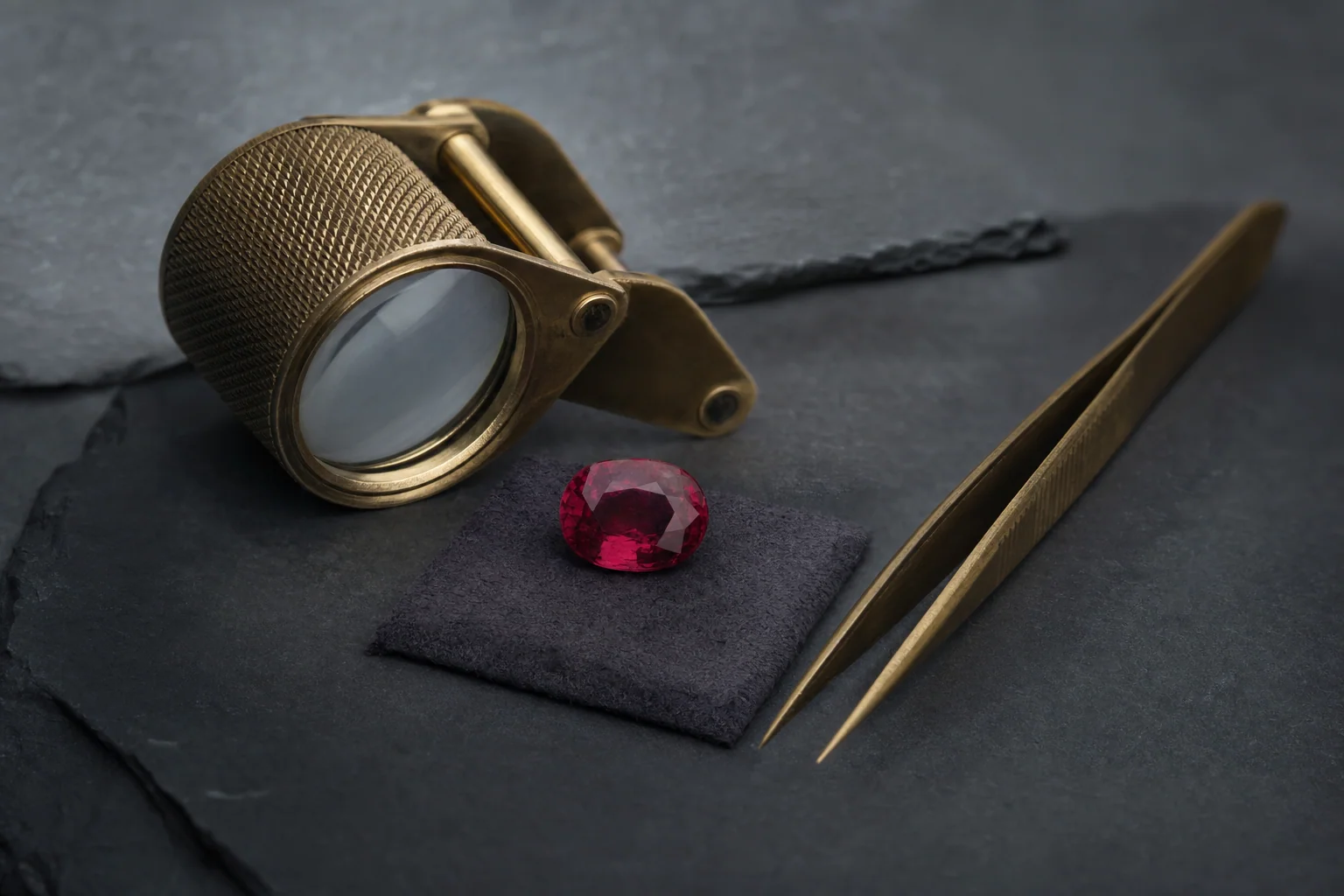
A stone arrives at the bench without a name. It is small, faceted, deep blue. The owner thinks it is a sapphire. The seller, two transactions ago, claimed it was a sapphire. The atelier has no certificate. The first job is not to weigh it, not to set it, not to value it — the first job is to find out what it is.
This is the daily work of a gemologist. The methods are not glamorous. They are precise, repeatable, and almost always done with the same handful of instruments that have sat on gemological benches for a century. What follows is what those instruments actually tell you, and what they do not.
The eye comes first
Before any instrument touches the stone, a trained eye works its way through three observations that, together, narrow the field by roughly an order of magnitude.
Body colour, under daylight. Hue, tone, and saturation, as discussed in The Art and Science of Describing Precious Stones. Note the colour in a north-facing window or under a colour-corrected daylight lamp; never in incandescent light, which warms everything by a hair and distorts the call.
Lustre. The way the surface returns light. Diamonds have an adamantine lustre — a hard, bright, almost metallic shine. Most other gems are vitreous, glass-like. A handful are subadamantine (zircon, demantoid garnet) or resinous (amber, some opals). Lustre alone can rule out entire categories.
Transparency. Transparent, translucent, or opaque. A transparent ruby and an opaque ruby are valued on different scales entirely.
These three observations, taken together, will tell you whether the stone you hold is plausibly a member of the species the owner claims it is. They will not tell you whether it is natural, synthetic, or treated. For that, the instruments.
The 10x loupe
The first instrument is the 10x loupe — a small magnifying lens that fits in a coat pocket. Every gemologist owns one. It is the workhorse of the trade: ninety per cent of identification work is done at 10x, and a great deal of treatment detection is, too.
Under 10x, you look for:
Inclusions. Are they crystalline, fingerprint-like, needle-like, two-phase (liquid and gas), curved? Different species carry different inclusion signatures. Natural emeralds carry their characteristic jardín; synthetic emeralds tend to have very few inclusions or, when they do, the inclusions are atypical (gas bubbles, curved growth lines).
Growth lines. Natural crystals grow in straight planes. Synthetic crystals grown by the flame-fusion method (Verneuil) grow in curved planes. A curved growth line under the loupe is a near-certain marker of a Verneuil synthetic.
Surface features. Polish quality, facet alignment, edge condition. A poorly polished facet meeting a sharply polished one suggests recent recutting — sometimes a sign that an older stone has been refurbished.
The loupe is also the diagnostic that catches the easy frauds. Glass imitations have gas bubbles in clusters that no natural stone exhibits. Doublets — a thin slice of natural stone fused to a glass back to make the piece appear larger — show a visible seam at the girdle.
The refractometer
If the loupe does not settle the species, the refractometer almost always does. This instrument measures refractive index — how much a stone bends light as light enters and exits.
Every gem species has a characteristic refractive index range. Diamond is 2.417 — high, hence the brilliance. Corundum (ruby and sapphire) is 1.762 to 1.770. Beryl (emerald, aquamarine) is 1.577 to 1.583. Quartz is 1.544 to 1.553. The refractometer can resolve to three decimal places, which is enough to distinguish almost every species from almost every other.
For singly refractive stones (diamond, garnet, spinel), the refractometer reads a single value. For doubly refractive stones (sapphire, emerald, tourmaline), it reads two values, separated by what is called the birefringence — a number that is itself diagnostic. A blue stone that reads doubly refractive with a birefringence of 0.009 is consistent with sapphire; a blue stone that reads doubly refractive with a birefringence of 0.020 is consistent with iolite.
The microscope
Where the loupe sees, the microscope diagnoses. A standard gemological microscope provides 10x to 70x magnification with darkfield illumination — light entering from the side rather than from below, so that inclusions appear bright against a dark background.
Under the microscope, the gemologist asks:
- Are the inclusions arranged in a pattern consistent with natural growth (zonal, planar, geological)?
- Are there fingerprint inclusions — networks of healed fractures full of fluid inclusions — that are diagnostic of natural origin?
- Are there silk inclusions (rutile needles in corundum) that are consistent with the claimed source?
- Are there bubbles, curved colour banding, or flux residues consistent with synthesis?
- Is there evidence of treatment — glass filling, oiling, beryllium diffusion?
This is the slowest and most skilled part of identification. A microscope can be used profitably only by someone who has memorised hundreds of inclusion types and the species and treatments they imply.
The spectroscope
The handheld spectroscope reveals which wavelengths of light a gemstone absorbs. Hold the stone in front of a bright light source, look through the prism eyepiece, and a black band appears in the spectrum at each wavelength the stone is absorbing.
The pattern of bands is a fingerprint. Natural ruby shows a distinctive triple absorption in the blue and a strong cut-off in the green — the signature of chromium. Cobalt-coloured glass shows three bands in the orange that no natural sapphire produces. Some treatments are detectable here too: heated sapphires sometimes show subtle differences in the iron absorption pattern compared to unheated stones.
The spectroscope is fast — a few seconds per stone — and excellent for ruling out the obvious wrongs.
The polariscope
The polariscope determines whether a stone is singly or doubly refractive. The stone is placed between two crossed polarising filters; if it stays dark as it is rotated, it is singly refractive (or amorphous). If it lightens and darkens four times per full rotation, it is doubly refractive. The test takes thirty seconds and resolves a question that would otherwise require a refractometer.
It is also a quick check for strain in the stone — a doubly refractive pattern in what should be a singly refractive material (e.g. apparent birefringence in glass) is a marker of internal stress, sometimes diagnostic of heat treatment.
What identification cannot tell you
Even a perfect identification — species, variety, natural origin, no treatment — does not tell you everything that matters. It does not tell you where the stone came from (origin determination requires laboratory-grade trace-element analysis, typically done at SSEF, Gübelin, or AGL). It does not tell you whether the export was ethical, the labour fairly paid, or the chain of custody clean. These are separate questions, answered by separate documentation. See our piece on the certification stack.
A serious atelier treats identification as the floor, not the ceiling. The floor is what stops you from setting glass in platinum. The ceiling is the stack of documents that, together, allow the wearer to know what they are wearing.
A short reference
- The eye first: body colour, lustre, transparency. Rules out most candidates.
- The 10x loupe: inclusions, growth lines, surface features. Catches the easy frauds.
- The refractometer: refractive index to three decimals. Settles species.
- The microscope: inclusion morphology under darkfield. Diagnoses natural vs synthetic and detects treatments.
- The spectroscope: absorption fingerprint. Fast and decisive.
- The polariscope: singly vs doubly refractive. Thirty seconds, ruling.
- What identification doesn’t tell you: origin, chain of custody, ethical sourcing. Those need a separate paper trail.
Anyone can buy a loupe. The trade is what to look for through it.